
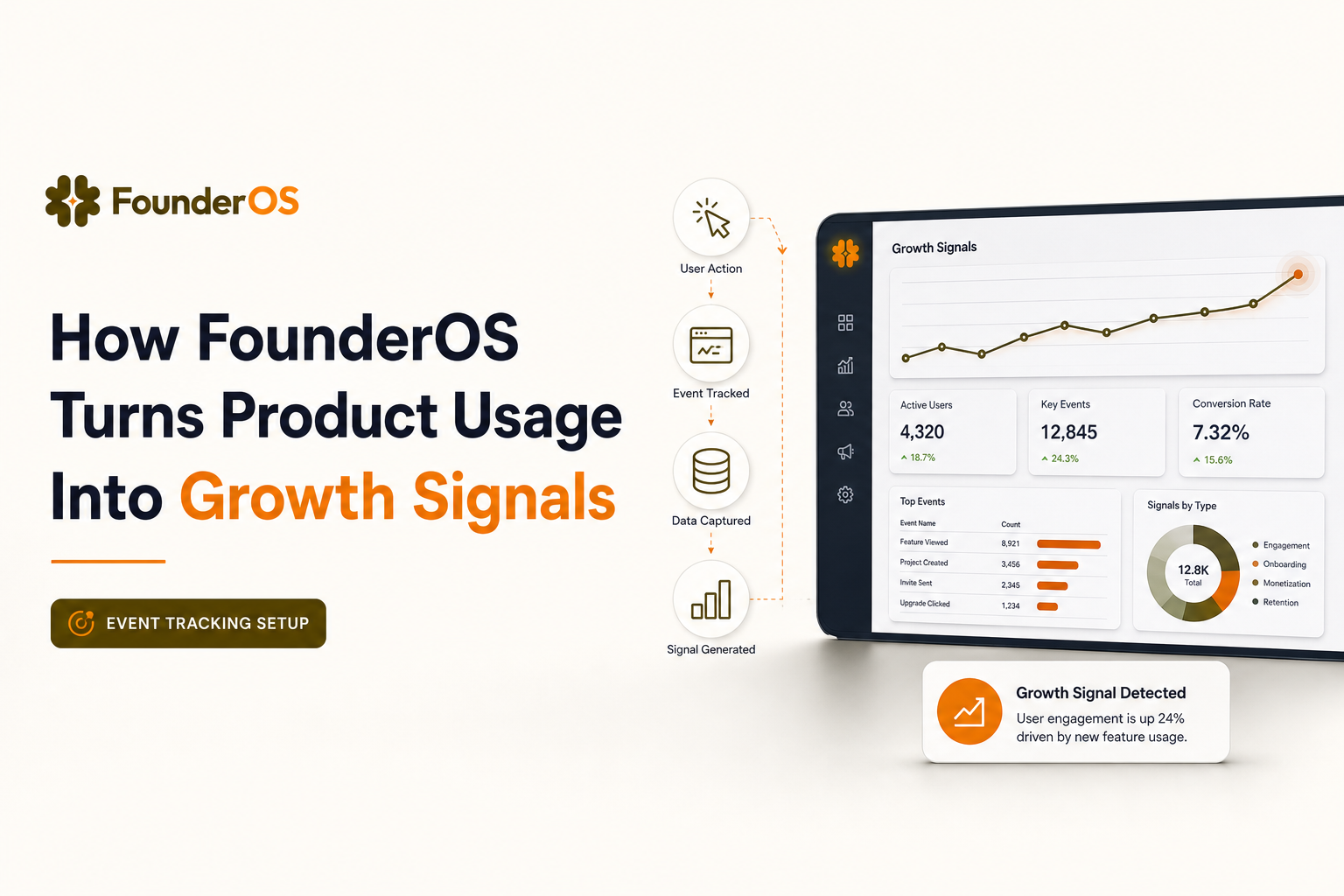
How FounderOS Turns Product Usage Into Growth Signals
Most SaaS companies still rely on weak buying signals
Many SaaS companies still evaluate lead quality using traditional signals like form submissions, demo requests, or signup volume. The problem is that these signals often appear too late, and in many cases, they do not reflect actual product adoption.
Some of the strongest buying signals usually happen inside the product itself. A user may never contact sales, yet spend days setting up their workspace, inviting teammates, connecting business data, and actively using important features. In reality, those accounts often have much higher conversion potential than someone who simply leaves an email address. The challenge is that most teams have no reliable way to identify those signals early enough.
That is the problem FounderOS is built to solve.
Product usage often reveals intent better than marketing metrics
For many SaaS products, user behavior inside the product says much more about purchase intent than traffic or signup numbers.
An account that completes onboarding, sets up tracking, uses important features consistently, and invites teammates is usually far more valuable than an account that signs up and disappears a few hours later.
FounderOS helps teams track these behaviors through event tracking and turns them into account quality signals that product, growth, and sales teams can actually use.
Instead of only looking at acquisition metrics, teams can start understanding:
which users are seriously adopting the product
which accounts are likely to convert
where onboarding friction happens
and which features are actually driving retention
FounderOS focuses on meaningful business events
FounderOS works based on event data sent directly from the client through integrations or SDK tracking. FounderOS does not automatically track events unless teams explicitly choose to send them. Teams decide which business events they want to track based on their own product and onboarding flow. This keeps data cleaner and reduces the amount of noise that usually appears in analytics systems.
Tracking meaningful product events
One common mistake many startups make when they first approach product analytics is trying to track too many events. Teams often end up tracking hundreds of UI interactions, only to create dashboards that become difficult to maintain and even harder to understand. In practice, many SaaS products only need around 10 to 20 meaningful business events to understand most of the onboarding and activation journey.
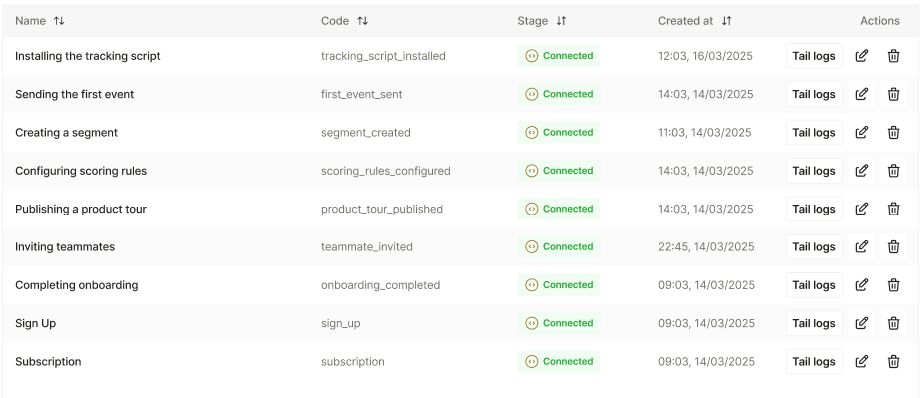
These events may seem small in number, but they reveal a lot about how users adopt the product, where onboarding friction happens, and which accounts are showing serious intent. FounderOS also uses these events to build onboarding funnels and account scoring systems. Instead of creating overly complex funnels with dozens of steps, many teams only need a few meaningful milestones to understand where users are dropping off and how long activation usually takes.
Building onboarding funnels
Once teams start tracking a smaller set of meaningful events, the next step is understanding how those events connect across the onboarding journey.
That is where onboarding funnels become valuable. Funnels help teams move beyond isolated event tracking and start understanding the actual progression of product adoption. Instead of simply knowing that users completed certain actions, teams can see how users advance through onboarding, where momentum slows down, and which milestones are most strongly connected to activation.
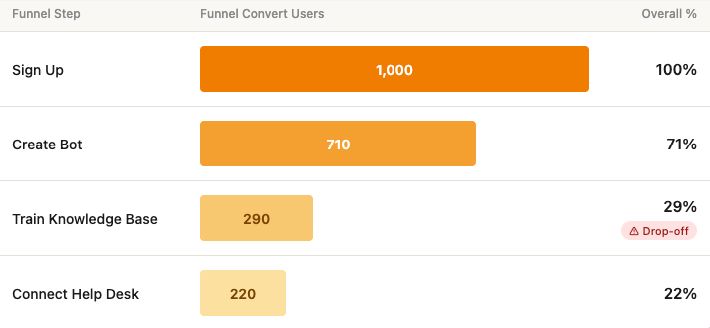
With a funnel like this, teams can immediately identify where users experience friction, how long activation typically takes, which onboarding stages create the biggest drop-offs, and which accounts successfully reach meaningful product usage.
Most importantly, funnels turn onboarding into something measurable. Instead of relying on assumptions about why users fail to activate, teams can use real behavioral data to identify bottlenecks, improve onboarding flows, and better understand which product milestones are actually driving adoption and conversion.
Turning raw events into account quality scores
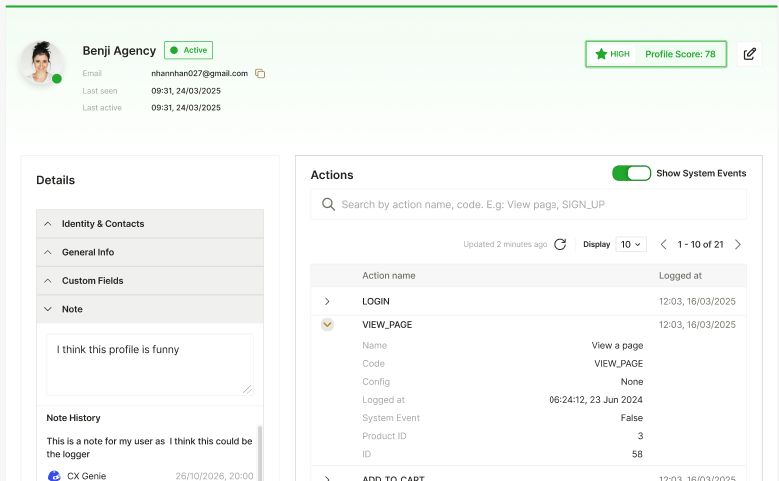
One of the biggest challenges in product analytics is that raw event data is often difficult for non-technical teams to interpret. Event logs can show who clicked something, who logged in, or who visited a page. But business teams usually care about a much simpler question:
Which accounts are actually likely to become paying customers?
FounderOS helps solve this by turning product events into an intent-based scoring model. Different actions can carry different weights depending on how strongly they correlate with adoption or conversion. For example, inviting teammates or setting up tracking may be far more meaningful than simply logging in every day.
This allows teams to identify high-intent accounts much earlier instead of waiting for demo requests or sales conversations.
Connecting product behavior with revenue data
One of the newer directions FounderOS is expanding into is connecting product behavior with revenue insights through Stripe integration.
Instead of only seeing which accounts are active, teams can now start understanding:
which accounts are generating MRR
which features are commonly used by paying customers
which user groups retain revenue better
and which behaviors tend to happen before conversion
The important part is not simply “viewing revenue.”
The real value comes from analyzing the behavior patterns of users who are actually generating revenue for the product.
For example, teams may discover that high-MRR accounts usually complete onboarding faster, create segments earlier, or invite teammates within the first few days. In some cases, teams even realize that the features they assumed were “core features” are not the features most strongly connected to conversion at all.
Those kinds of insights are difficult to see when revenue data and product behavior live in separate systems.
That is where product analytics becomes much more valuable than a reporting dashboard.
Product analytics should lead to action
Many analytics platforms today collect enormous amounts of data but still leave teams unsure about what actions to take next.
FounderOS is designed differently.
The goal is not simply to track more events, but to help teams better understand which accounts are truly receiving value from the product and which behaviors are connected to retention, conversion, and revenue growth.
For example:
if users frequently drop at the “send first event” step, onboarding may be too technical
if accounts with teammate invites retain better, collaboration features should appear earlier
if users who publish product tours convert better, those features should become more visible during setup
When product behavior is connected with onboarding funnels, account scoring, and revenue insights, teams can make product decisions based on real usage patterns instead of assumptions.
Conclusion
In SaaS, not every signup has the same value. What matters more is what users actually do after signup.
By combining event tracking, funnel analysis, account scoring, and revenue insights, FounderOS helps teams detect high-intent accounts earlier and better understand which product behaviors are truly connected to conversion and growth.
Instead of collecting data just to fill dashboards, FounderOS helps turn product behavior into actionable growth signals.
Ivy Tran
Stay in the loop
Get the latest insights on SaaS growth, product strategy, and more delivered to your inbox.