
How to Fix Lead Scoring and Build a Predictable Sales Pipeli
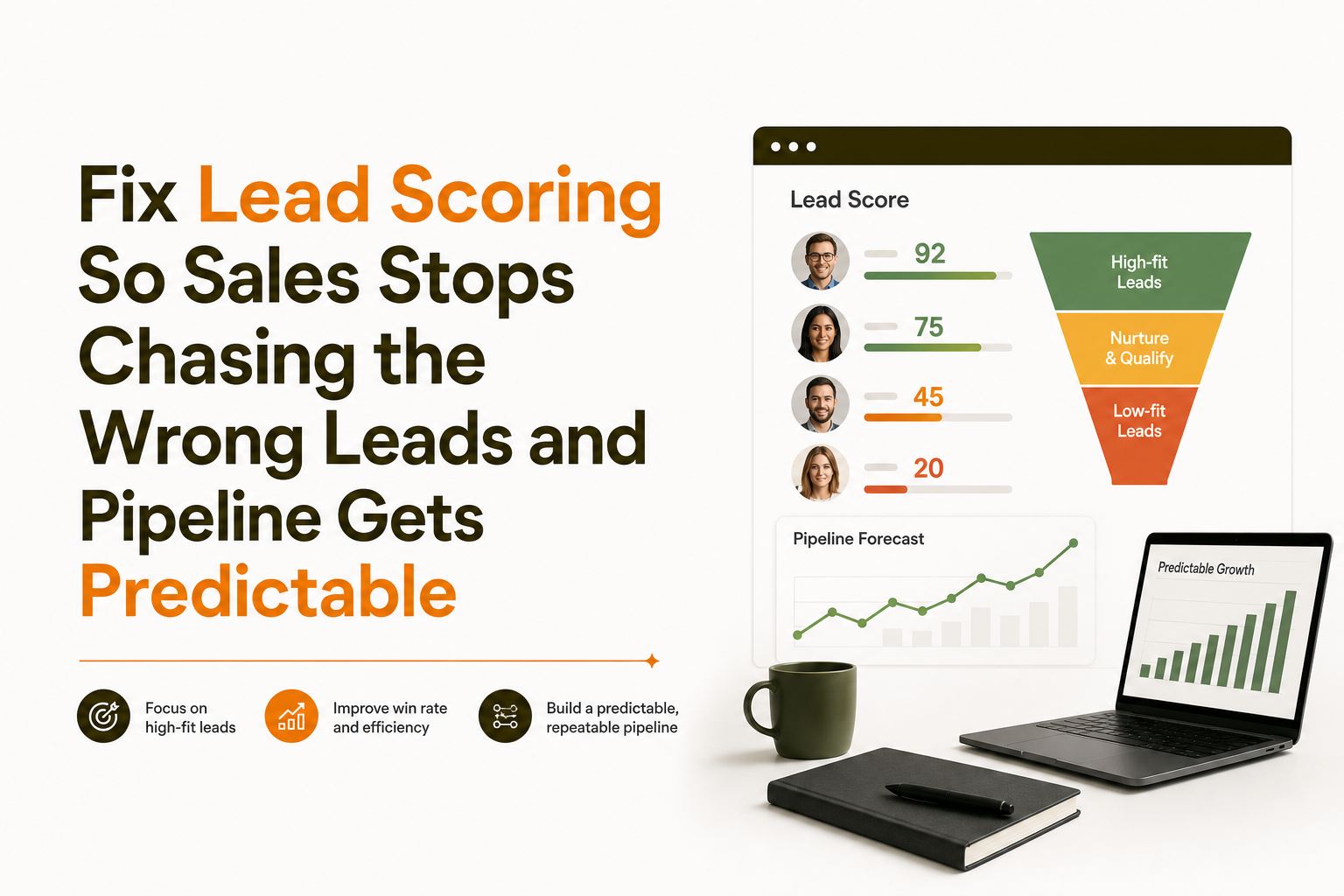
Direct answer: Lead scoring works when you score two things separately (fit and intent), prove the score predicts revenue using your own data, and route follow-up based on clear thresholds. If your lead scoring is based on guesses, you will over-contact low-value signups and miss high-intent accounts that were ready this week.
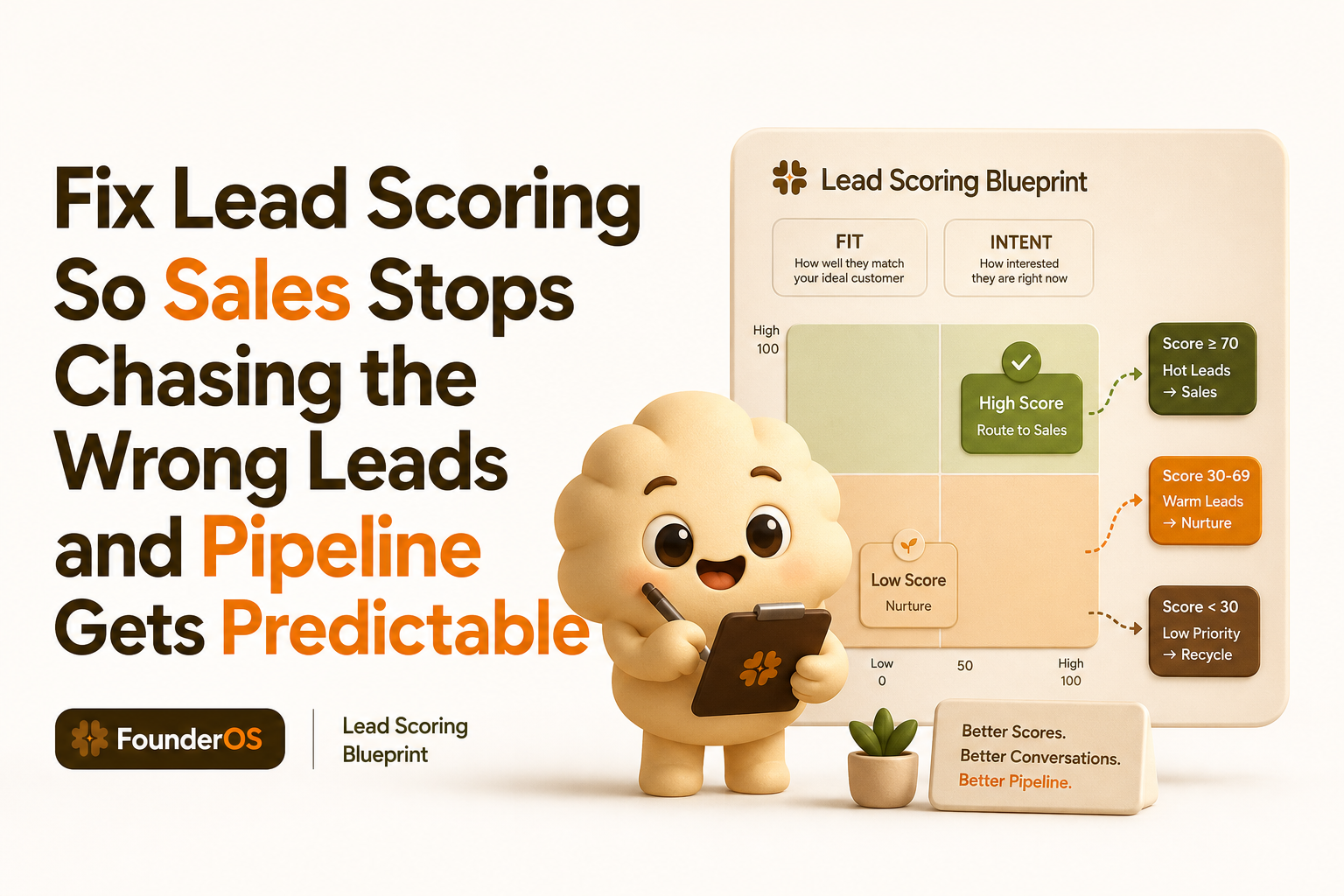
- Split lead scoring into Fit (who they are) and Intent (what they do), then combine them into one action rule.
- Only keep scoring signals that predict a paid outcome in your own history, not what “sounds good.”
- Route leads with two thresholds (fast-track and nurture) to protect sales time and improve follow-up speed.
The Agitation: Why Lead Scoring Is Costing You Money, Time, and Reputation
Most teams do not have a lead volume problem. They have a mis-prioritization problem. Broken lead scoring quietly creates three compounding costs that show up as “sales is not following up” or “marketing leads are low quality.”
- Wasted sales hours (the obvious cost): If an SDR spends 6 minutes researching and 4 minutes attempting outreach, that is 10 minutes per lead. At 40 leads/day, one rep can burn ~6.5 hours/day on the wrong people. Multiply by 2-3 reps and you have a full-time headcount spent on noise.
- Lost high-intent deals (the invisible cost): The leads you miss are usually not “bad.” They are quiet. They do not fill every form field, but they do high-intent actions: revisit pricing, invite a teammate, or complete the setup step that correlates with activation. If your lead scoring ignores behavior, you respond too late.
- Reputation and deliverability damage (the compounding cost): Over-contacting low-fit signups increases spam complaints and unsubscribes. That degrades email performance over time, which then reduces your ability to reach the leads that actually matter. For a credible overview of how sender reputation impacts deliverability, see Google’s email sender guidance.
Here is the uncomfortable truth: lead scoring is not a spreadsheet problem. It is a measurement problem. If you cannot show that a score predicts a concrete outcome (demo booked, trial activated, paid conversion), your “score” is just a label.
The Strategic Blueprint to Overcome Broken Lead Scoring
This is a practical lead scoring blueprint you can implement without a data team. The goal is simple: create a score that changes behavior (who gets contacted, when, and with what message) and proves it improves outcomes.
Step 1: Define the one outcome your lead scoring must predict
Pick one primary outcome for the next 30 days. Examples:
- B2B SaaS with sales-assist: “Demo booked within 7 days of signup.”
- Product-led with sales later: “Activated within 3 days” (define activation as one key action completed).
- High-touch: “Qualified meeting held” (not just scheduled).
Checklist: Your outcome must be (1) measurable, (2) time-bound, (3) tied to revenue later.
Step 2: Split signals into Fit vs Intent (do not mix them)
Clean lead scoring separates:
- Fit signals: company size range, industry, job role, region, existing tools (from form fields or enrichment).
- Intent signals: behavior such as returning to pricing, inviting a teammate, using a core feature, or hitting a usage threshold.
Rule: Fit answers “Should we sell to them?” Intent answers “Are they ready now?” You need both to prioritize correctly.
Step 3: Build a 2x2 routing rule before you build a “score”
Before you assign points, decide what happens operationally. Use this 2x2:
| Fit | Intent | What Sales Does |
|---|---|---|
| High | High | Fast-track: call or personal email within 15 minutes to 2 hours |
| High | Low | Nurture: targeted sequence, wait for intent trigger |
| Low | High | Disqualify or self-serve: offer resources, do not spend rep time |
| Low | Low | Ignore: remove from sales queue, protect deliverability |
Now your lead scoring has a job: move leads between these boxes based on observed evidence.
Step 4: Keep only 6 to 10 signals and force them to “earn a spot”
Teams fail by adding too many weak signals. Start with a short list and validate. A tight starting set:
- Visited pricing page 2+ times in 7 days (intent)
- Completed setup step (intent)
- Invited teammate (intent)
- Used core feature twice (intent)
- Company size in target range (fit)
- Role matches buyer/user (fit)
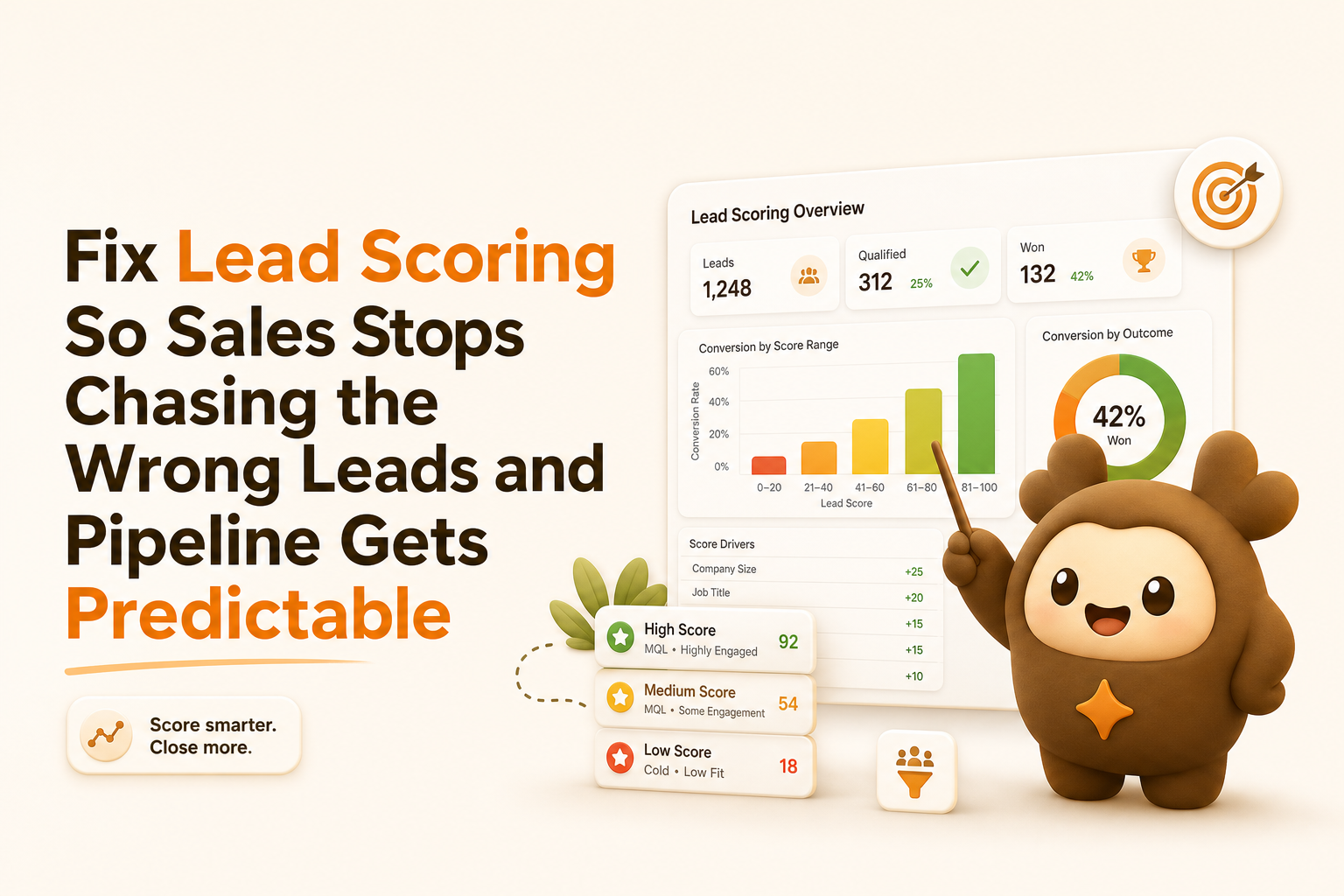
Benchmarking method (simple): Look back at the last 30 to 90 days. For each signal, compare conversion rate for leads with the signal vs without it. If the lift is small, remove it. If you do not have enough data, keep the signal but mark it “unproven.”
Expert Insight (contrarian): Stop over-weighting form fields. In early-stage and mid-market SaaS, the most reliable early predictor is often “time-to-first-value behavior” (did they reach the meaningful action fast?), not job title. Titles can be wrong. Behavior is harder to fake.
Step 5: Set two thresholds and measure weekly drift
Use two thresholds so your system does not collapse into “everything is hot”:
- Fast-track threshold: triggers immediate sales follow-up.
- Nurture threshold: triggers automated education until intent increases.
Weekly check (15 minutes):
- How many leads crossed fast-track?
- What percent booked a meeting (or activated) within your time window?
- Which signal produced the most false positives?
This is how lead scoring stays ROI-positive: you prune signals that waste time.
Solving Lead Scoring in Under 10 Minutes with Founder OS
If you already have a blueprint, the bottleneck becomes execution: collecting behavior consistently, segmenting reliably, and seeing where leads drop off. Founder OS can be used as the “measurement layer” to implement lead scoring faster, using product behavior as intent signals.
Behavior-Based Scoring: Turn “What They Did” Into Intent You Can Trust
Tool for the job: Product Tracking + real-time events.
- What you do in minutes: install once, then watch key actions appear in a live event stream.
- Measurable output: a verified list of users who performed high-intent actions (pricing visits, key feature use, repeated sessions) in the last 1 to 7 days.
This replaces “gut feel” lead scoring with observable intent.
Segments That Update Themselves: Keep Hot Leads Hot Without Manual Lists
Tool for the job: User Profiles + Segmentation.
- What you build: a “High Fit, High Intent” segment based on profile attributes plus behavior sequences.
- Measurable output: a live audience that automatically adds/removes leads as they act, so sales is not working from stale exports.
Funnel Proof: Validate That Your Lead Scoring Predicts the Outcome
Tool for the job: Funnel Analysis.
- What you check: whether the “fast-track” segment actually moves through your key steps at a higher rate.
- Measurable output: a conversion rate comparison between scored cohorts, so you can remove signals that do not predict results.
10-minute implementation plan:
- Pick 1 outcome (demo booked or activation event).
- Pick 3 intent events and 2 fit traits.
- Create 2 segments: Fast-track and Nurture.
- Review weekly: segment size, outcome rate, and false positives.
FAQ
What is lead scoring in one sentence?
Lead scoring is a rule-based or data-based way to rank leads so your team contacts the right people first, using fit (who they are) and intent (what they do).
How many signals should a lead scoring model use?
Start with 6 to 10 signals. If you need more than that to feel confident, it usually means you have not defined a single outcome to predict or you are mixing fit and intent into one messy list.
Should lead scoring be the same for every industry?
No. Fit signals vary by industry, and intent signals vary by product. The structure stays the same (fit + intent + thresholds), but the specific signals must be validated against your own outcomes.
How do I know if my lead scoring is working?
It is working if (1) fast-track leads convert at a meaningfully higher rate than average, (2) sales time spent per booked meeting goes down, and (3) the model stays stable when you review it weekly and remove false-positive signals.
If you want to implement behavior-based lead scoring this week, start by tracking the few actions that signal real intent and building two live segments. Founder OS can help you capture user behavior, build those segments, and validate the scoring with funnels. Start free and get your first intent-based segment running in minutes.

Stay in the loop
Get the latest insights on SaaS growth, product strategy, and more delivered to your inbox.