
Funnel Analysis for B2B SaaS From Clean Instrumentation to Better Conversion Rates
A pragmatic funnel analysis playbook for B2B SaaS: define steps, validate conversions with SQL, segment drop-offs, and turn insights into tests.

Funnel analysis is only useful when your step conversions are trustworthy, your windows are explicit, and your segments explain why users drop off rather than just where they drop off.
- Define funnels as ordered steps plus clear time windows and exclusions, so your numbers match real SaaS journeys.
- Validate tool-reported conversion with QA checks and a few SQL patterns (ordered, deduped, and windowed) before you ship decisions.
- Segment drop-offs by behavior and profile context, then prioritize fixes into experiments you can actually run.
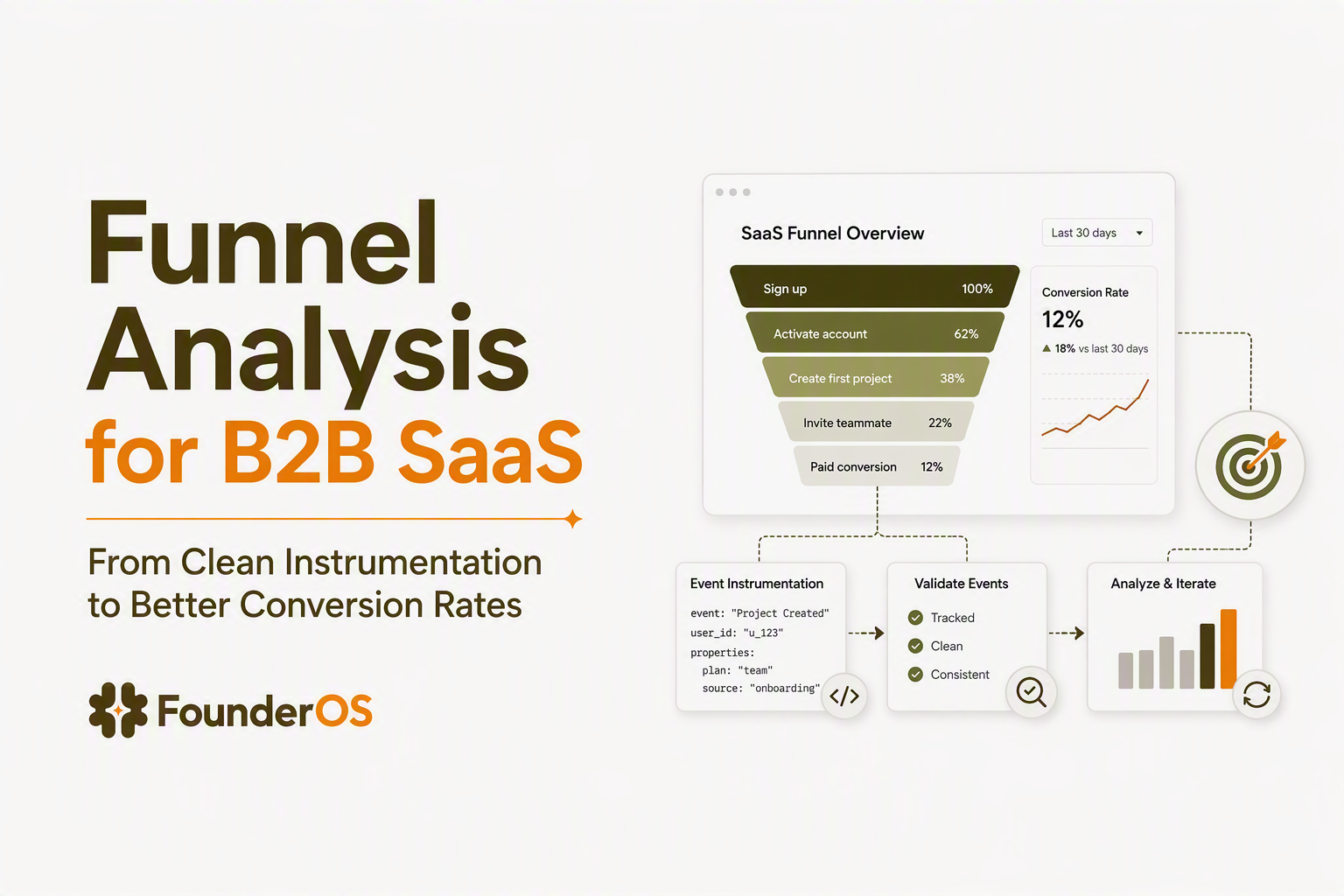
Define a funnel that holds up in real SaaS journeys
A funnel that holds up operationally is an ordered set of measurable events with explicit rules for timing, identity, and who is excluded.
Start from one decision and work backward into 4 to 7 steps
Skip abstract stage names and define a single outcome your team is optimizing this quarter, then list the minimal user actions that must happen in order. For B2B SaaS activation, a common outcome is “created first valuable object” or “invited teammate,” but the steps must be your product’s reality.
- Outcome event: the first moment value is realized (ex:
project_createdorfirst_report_viewed). - Preconditions: actions that must precede it (ex:
signup,email_verified,workspace_created). - Friction steps: events that often fail silently (ex:
integration_connected,billing_page_viewed).
Rule of thumb we use: if a step does not change what a user can do next, it is usually a diagnostic event, not a funnel step. Keep it out of the core funnel and analyze it as a breakdown instead.
Choose identity and ordering rules that match how people actually use B2B SaaS
Decide, in writing, what “a user” means for this funnel: authenticated user ID, workspace ID, or an account-level actor. If your product supports invites, switching devices, or SSO, you will also need a merge rule that connects pre-auth activity to the eventual user.
- Identity:
user_idfor activation,account_idfor sales-assisted conversion,workspace_idfor collaboration products. - Ordering: use event timestamps, but define how you handle ties and ingestion delay (keep reading for SQL patterns).
- Deduping: define whether repeated steps count once (typical) or many times (rare, usually for usage funnels).
In our experience working with founder-led SaaS teams, the fastest way to break funnel analysis trust is mixing identities inside the same funnel, for example counting step 1 by anonymous cookie and step 3 by user_id without a join strategy.
Set conversion windows and exclusions before you look at results
Conversion windows turn subjective debates into testable assumptions. A practical pattern is a short window for activation (hours to days) and longer for sales or onboarding completion (days to weeks), but the right choice depends on your product cycle.
- Per-step window: max time allowed between step N and step N+1 (ex: 24 hours).
- Overall window: max time allowed from step 1 to final step (ex: 7 days).
- Exclusions: internal users, QA workspaces, and events from scripted monitoring.
If you run a product analytics platform such as Founder OS, the practical implementation is to keep the funnel definition tight, then use user segmentation to explore non-linear side paths rather than stuffing extra optional steps into the main chain.
Calculate funnel performance without lying to yourself
Accurate funnel analysis requires reporting both step conversion and time-to-convert, plus running a short QA checklist to catch identity, duplication, and windowing mistakes.
Compute the four numbers you actually act on
- Step conversion: users who reached step N+1 divided by users who reached step N.
- Overall conversion: users who reached final step divided by users who entered step 1.
- Step drop-off count: users who reached step N but not step N+1 (within your window).
- Time-to-convert distribution: median and percentiles from step 1 to final step and between steps.
Time-to-convert prevents a common failure mode: a funnel “improves” because you shortened the window, or “worsens” because users take longer due to a UI change, even though ultimate conversion is stable.
QA checklist before trusting any dashboard
Run these checks on every new funnel, especially when instrumenting for the first time or migrating tools.
- Event uniqueness: confirm each step has a stable event name and the payload needed to filter (ex: plan, workspace, feature).
- Identity completeness: measure what percentage of events have
user_idand whether anonymous events are merged. - Duplicate firing: spot multiple identical events within seconds from debounce issues or retries.
- Backfilled and late events: verify whether ingestion time differs materially from event time.
- Internal traffic: ensure employees, test tenants, and automated monitors are excluded consistently.
What surprised our team was how often “missing conversion” was a join issue: step 2 existed, but it was tracked under a different identity key than step 1, so the funnel looked broken even though users were progressing.
Tooling decision criteria for trustworthy funnels
When evaluating product analytics tooling for funnel analysis, prioritize: event collection reliability, identity resolution, fast segmentation, and the ability to drill from aggregate drop-off into individual user sessions.
- Reliability: real-time visibility into event streams so you can validate instrumentation quickly.
- Segmentation depth: break down by behavior sequences, recency, and profile attributes, not only static traits.
- Explainability: click from funnel steps into user-level timelines to see what happened next.
Founder OS is built around that workflow: install once, see events within seconds, and then use profiles and segments to move from “where is the drop-off” to “which users are dropping and what they did instead.”
Funnel analysis SQL recipes you can copy-paste
SQL-based funnel analysis is the fastest way to validate tool-reported conversion because it forces you to define ordering, deduplication, and windows explicitly.
Assumed event table and notes
Examples below assume a table like events(user_id, event_name, event_time, event_id). If you have both event_time and ingested_at, always order by event_time and keep ingested_at for QA.
Recipe 1: Ordered funnel, first occurrence per step
WITH step1 AS (
  SELECT user_id, MIN(event_time) AS t1
  FROM events
  WHERE event_name = 'signup'
  GROUP BY 1
),
step2 AS (
  SELECT e.user_id, MIN(e.event_time) AS t2
  FROM events e
  JOIN step1 s ON s.user_id = e.user_id
  WHERE e.event_name = 'workspace_created'
    AND e.event_time >= s.t1
  GROUP BY 1
),
step3 AS (
  SELECT e.user_id, MIN(e.event_time) AS t3
  FROM events e
  JOIN step2 s ON s.user_id = e.user_id
  WHERE e.event_name = 'project_created'
    AND e.event_time >= s.t2
  GROUP BY 1
)
SELECT
  COUNT(*) AS step1_users,
  COUNT(step2.user_id) AS step2_users,
  COUNT(step3.user_id) AS step3_users
FROM step1
LEFT JOIN step2 USING (user_id)
LEFT JOIN step3 USING (user_id);
Why it works: each step is the first valid occurrence after the previous step. What it misses: window limits and per-step time-to-convert.
Recipe 2: Add an overall conversion window (ex: 7 days)
...
step3 AS (
  SELECT e.user_id, MIN(e.event_time) AS t3
  FROM events e
  JOIN step2 s ON s.user_id = e.user_id
  JOIN step1 s1 ON s1.user_id = e.user_id
  WHERE e.event_name = 'project_created'
    AND e.event_time >= s.t2
    AND e.event_time <= s1.t1 + INTERVAL '7 days'
  GROUP BY 1
)
...
Common pitfall: applying the 7-day window between steps rather than from entry can inflate conversion by giving each step a fresh clock.
Recipe 3: Per-step windows to catch “stalled” users
WITH step1 AS (...),
step2 AS (
  SELECT e.user_id, MIN(e.event_time) AS t2
  FROM events e
  JOIN step1 s ON s.user_id = e.user_id
  WHERE e.event_name = 'workspace_created'
    AND e.event_time BETWEEN s.t1 AND s.t1 + INTERVAL '24 hours'
  GROUP BY 1
),
step3 AS (
  SELECT e.user_id, MIN(e.event_time) AS t3
  FROM events e
  JOIN step2 s ON s.user_id = e.user_id
  WHERE e.event_name = 'project_created'
    AND e.event_time BETWEEN s.t2 AND s.t2 + INTERVAL '24 hours'
  GROUP BY 1
)
SELECT ...;
Use it when: your activation definition implies urgency, for example users must reach value in the first session or first day.
Recipe 4: Dedupe noisy events with an event_id or time bucketing
WITH deduped AS (
  SELECT DISTINCT user_id, event_name, event_time, event_id
  FROM events
  WHERE event_id IS NOT NULL
),
step1 AS (
  SELECT user_id, MIN(event_time) AS t1
  FROM deduped
  WHERE event_name = 'signup'
  GROUP BY 1
)
...
If you do not have a stable event_id, bucket by a small time window (for example floor to 5 seconds) and dedupe on (user_id, event_name, bucket). The goal is to remove accidental double fires without erasing legitimate repeated actions.
Recipe 5: Time-to-convert output you can chart
WITH step1 AS (...), step3 AS (...)
SELECT
  percentile_cont(0.5) WITHIN GROUP (ORDER BY (t3 - t1)) AS p50_time_to_convert,
  percentile_cont(0.9) WITHIN GROUP (ORDER BY (t3 - t1)) AS p90_time_to_convert
FROM step1
JOIN step3 USING (user_id);
Interpretation: if p90 balloons after a release while p50 is stable, you likely introduced an edge-case blocker that affects a minority cohort.
Diagnose drop-off by segment, then turn insights into experiments
Segmented funnel analysis turns “40% drop at step 2” into an actionable hypothesis by revealing which users drop, what they do instead, and what to test first.
Segment with a bias toward behavior, not demographics
Start with behavioral cohorts that map to product intent and friction. Examples that consistently produce signal:
- Acquisition path: source channel, campaign, or landing page variant.
- First-session actions: viewed onboarding, clicked integration, opened settings, invited teammate.
- Recency and frequency: returned within 24 hours, performed core action twice, or stalled after one attempt.
- Role context: admin vs member if your app has permissions that can block progress.
In our experience, the cleanest segmentation workflow is: build one canonical funnel, then reuse it across cohorts side by side so you do not accidentally change definitions while comparing segments. Founder OS supports this style by letting segments refresh in real time as users act, which matters when you are iterating on onboarding weekly.
Prioritize fixes with an impact-effort grid tied to the funnel math
Use a simple scoring model so the team stops debating anecdotes.
- Impact: step drop-off count multiplied by expected lift (even a small lift on a high-volume step is large).
- Confidence: evidence strength (session replays, support tags, error logs, user interviews).
- Effort: engineering and design time, plus risk of breaking other flows.
After running multiple activation audits, the pattern was clear: teams get more lift by fixing the single biggest leak first than by spreading experiments across five micro-steps, because the upstream volume makes downstream improvements harder to detect.
Turn segments into tests that can actually be shipped
Convert each segment insight into one of four experiment types, each tied to an observable event change:
- Remove a blocker: fix an error state, permissions issue, or integration failure and track reduced “dead-end” events.
- Shorten time-to-value: change defaults, templates, or guided setup and track faster step-to-step times.
- Clarify next action: improve empty states or call-to-action placement and track higher click-through into the next step.
- Personalize onboarding: show different tours based on role or intent and track improved step 2 conversion in that cohort.
Founder OS can close the loop here because the same segments you use for diagnosis can be routed into onboarding tours, so the experiment target stays consistent with the analysis target.
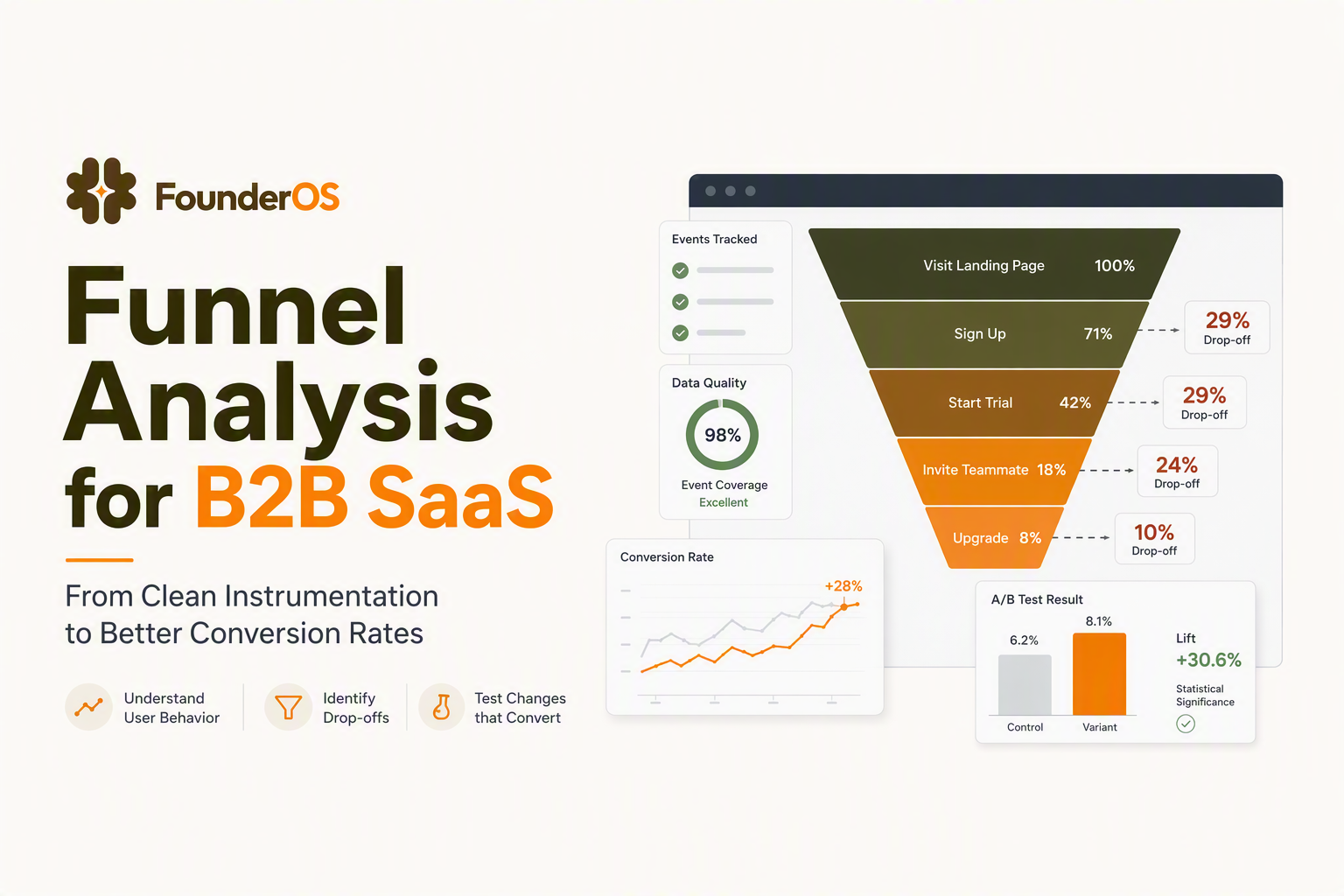
| Funnel analysis checkpoint | What to verify | Evidence artifact to save |
|---|---|---|
| Definition | Ordered steps, identity key, overall and per-step windows, exclusions | One-page funnel spec in your repo or docs |
| Instrumentation | Event names stable, properties present, duplicates controlled, identity merged | Event dictionary and a sample of raw events |
| Validation | Tool funnel matches SQL within expected tolerance after exclusions | SQL query + snapshot results by date range |
| Segmentation | At least 3 behavioral cohorts explain variance in drop-off or time-to-convert | Cohort definitions and side-by-side funnel export |
| Experiment | One hypothesis per leak, success metric per step, rollout plan | Experiment brief with expected funnel movement |
FAQ
How many steps should a SaaS funnel have?
Most activation funnels work best with 4 to 7 steps. Fewer steps hide where friction happens, while more steps create noisy “micro-drop-offs” that are hard to fix and harder to measure.
Why does my dashboard funnel not match my SQL funnel?
The usual causes are different identity rules (anonymous vs logged-in), different windowing (per-step vs overall), and deduplication differences. Validate with one ordered, deduped SQL query and make the tool match that definition.
What is the minimum SQL I need to validate funnel analysis?
You need an ordered funnel query that selects the first valid occurrence of each step after the previous one, plus at least one window rule. From there, add deduping and time-to-convert percentiles if your product has long onboarding cycles.
How do I decide which drop-off to fix first?
Start with the step that loses the most users in absolute count, then check whether the drop-off concentrates in a segment you can target. Prioritize changes with high impact, strong evidence, and low effort, and measure movement at that specific step.
If you want to run this playbook end-to-end faster, Founder OS gives you event tracking, user profiles, segmentation, and funnels in one place, plus onboarding flows to test fixes immediately. Book a demo to validate your instrumentation, reproduce your funnel analysis with the SQL patterns above, and identify the single highest-impact drop-off to tackle next.
Read Next
View all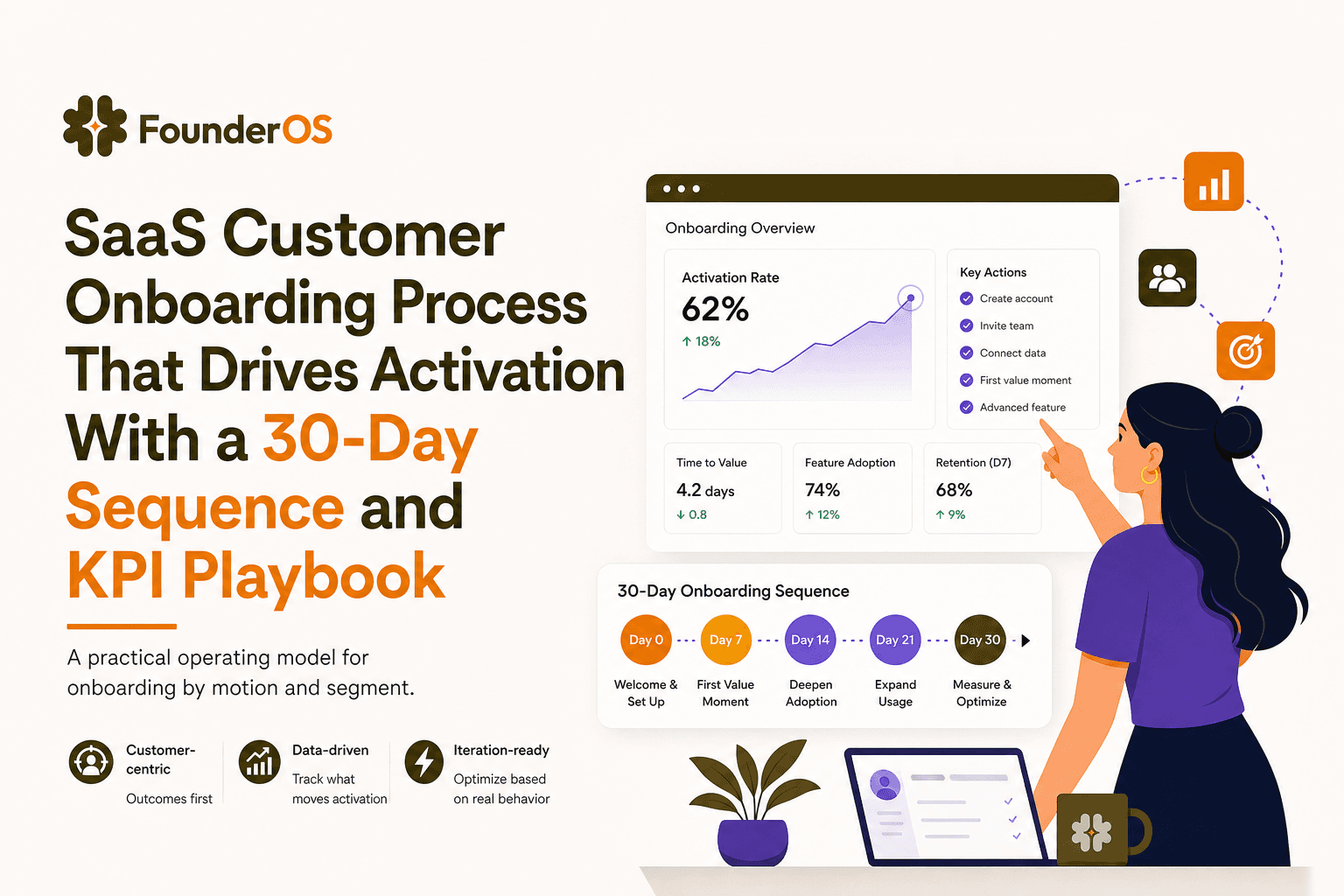
SaaS Customer Onboarding Process That Drives Activation With a 30-Day Sequence and KPI Playbook
Build a saas customer onboarding process with a 30-day sequence, triggers, RACI ownership, and KPI formulas to reach activation faster.


Product Analytics Platforms Compared: FounderOS vs Mixpanel
Compare product analytics platforms: Founder OS vs Mixpanel on setup time, learning curve, scalability, integrations, and cost-per-output.
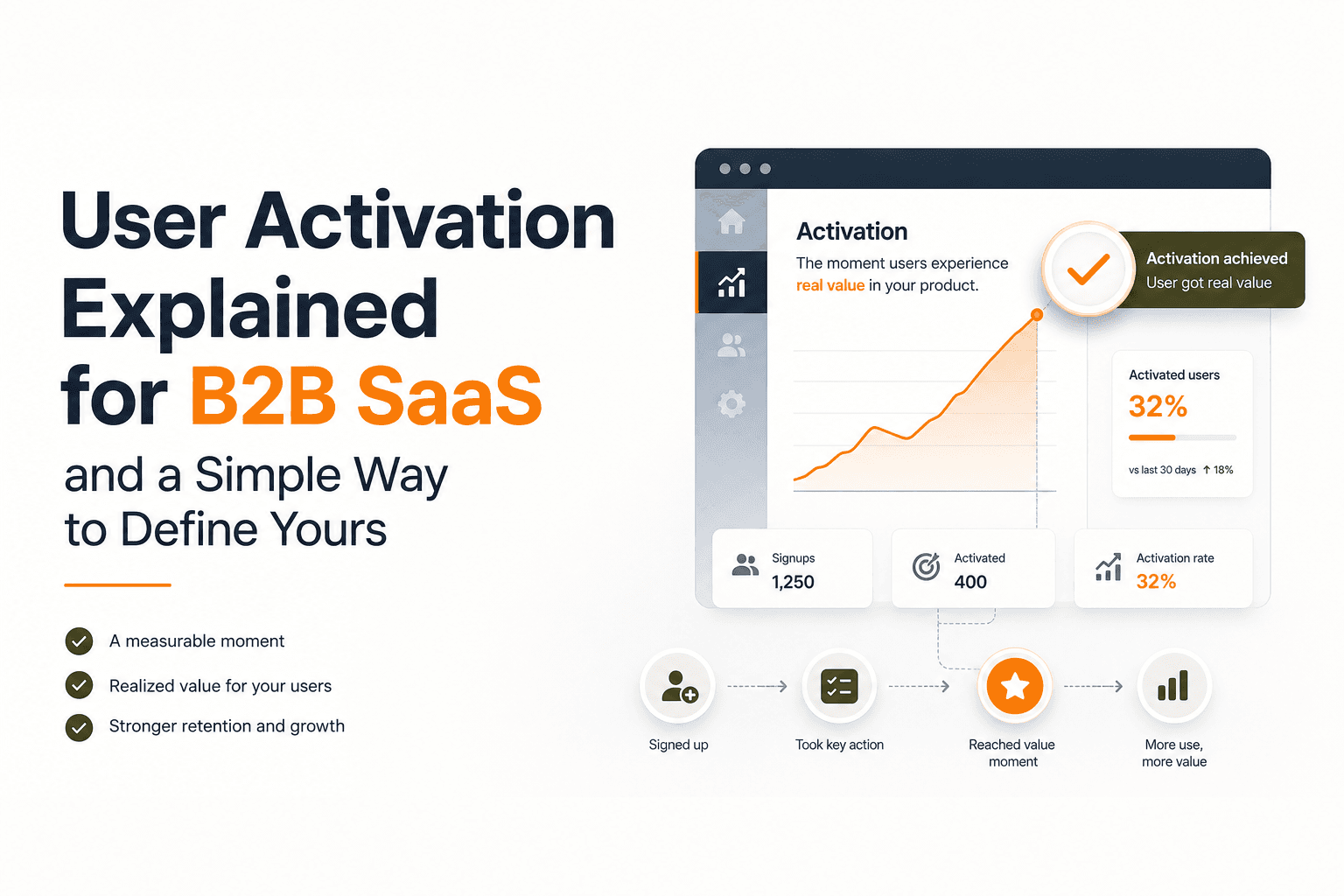
User Activation Explained for B2B SaaS and a Simple Way to Define Yours
Learn what user activation means in B2B SaaS and how to define one measurable activation moment using event tracking and a simple funnel.