
Sales Funnel Strategy, A Measurement-First Framework for B2B SaaS Growth

A sales funnel strategy gives a B2B SaaS team a measurable operating model for turning buyer intent into qualified opportunities, revenue, and long-term customers. Instead of treating marketing and sales as separate activities, the strategy connects each buyer action to a defined stage, owner, conversion metric, and next step.
- Choose a simple stage model, then define entry triggers and exit criteria for every step.
- Measure conversion between stages, not just traffic, leads, or closed revenue.
- Use recovery actions to address the highest-value leak before adding more acquisition spend.
What a Sales Funnel Strategy Is and Why SaaS Teams Need One
A sales funnel strategy is a documented system that maps buyer intent to observable actions, accountable owners, and measurable progression. A visitor reading a comparison page, for example, has shown interest, but that action alone does not make the person sales-ready. A stronger system records what happened next, such as a pricing visit, product signup, demo request, or repeated use of a high-value feature.
The practical problem is usually not a lack of data. SaaS teams often have website analytics, CRM records, email reports, and product events, but no shared definition of progress. Marketing may report leads, sales may report meetings, and product may report activation while leadership cannot explain where commercial momentum is being lost.
Use four rules to make progression measurable
- Use observable entry triggers: Define the action that places a person or account into a stage. Examples include downloading a guide, completing a signup, booking a meeting, or inviting a teammate.
- Set an exit criterion: A stage is complete only when the buyer completes a meaningful action, not when a team member changes a status field.
- Assign one owner: Shared responsibility can support execution, but one person or team must own the next action and its timing.
- Track stage conversion: Calculate the percentage moving from one defined stage to the next over the same cohort and time period.
In practice, I start with a single commercial question: “What evidence tells us this buyer is progressing?” That question often removes vague labels such as “warm lead” and replaces them with actions that can be counted, reviewed, and improved.
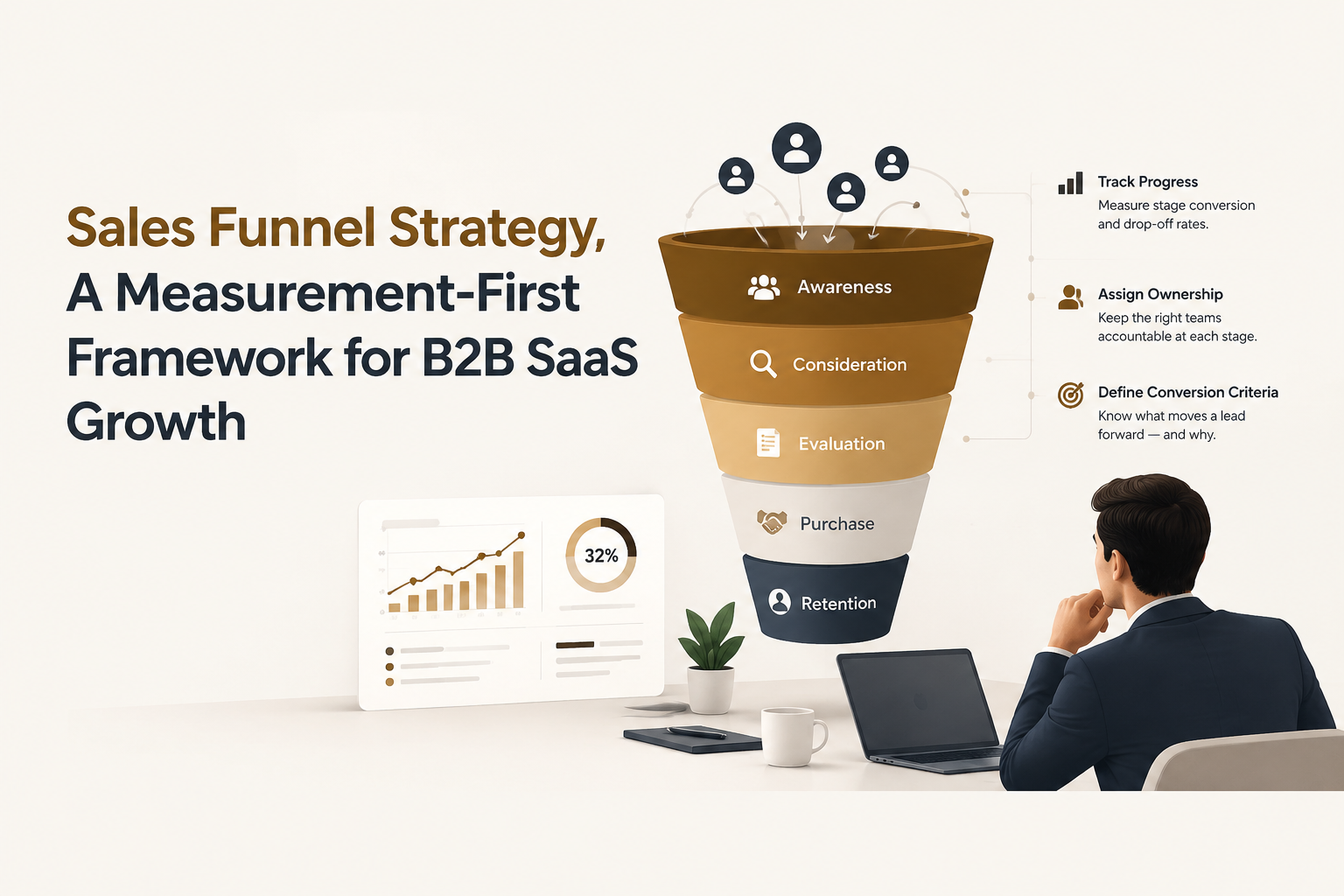
Choose a Sales Funnel Strategy Model and Connect Marketing to Sales
The right sales funnel strategy model is the simplest structure that preserves important buyer decisions without creating unnecessary handoffs. Four common models use four, five, six, or seven stages, but the number matters less than the criteria attached to each stage.
| Model | Typical stages | Best use | Main risk |
|---|---|---|---|
| Four stages | Awareness, consideration, decision, retention | Early planning and executive reporting | Too broad for operational diagnosis |
| Five stages | Awareness, interest, consideration, intent, purchase | Content and demand measurement | Marketing and sales definitions may diverge |
| Six stages | Awareness, lead, qualified lead, opportunity, customer, expansion | B2B SaaS teams with a sales motion | Qualification can become subjective |
| Seven stages | Awareness, engagement, lead, qualification, evaluation, purchase, advocacy | Complex journeys and account-based selling | More administration and slower reporting |
Make the handoff explicit
A marketing-to-sales handoff should include three facts: the qualifying action, the context collected, and the required response time. For example, a lead may become sales-qualified after requesting pricing and attending a product walkthrough. The handoff record should include source, company size, use case, pages viewed, and the agreed follow-up owner.
The 3-3-3 rule is a useful operating check: define three qualification signals, require three pieces of useful context, and set a three-business-day maximum for the first meaningful response. It is not a universal benchmark, but it creates a clear starting standard that teams can adjust using their own data.
The five Cs provide a complementary review: customer, context, content, conversation, and conversion. Review each one at every handoff. If conversion is weak, ask whether the customer is correctly defined, the context is sufficient, the content answers the current concern, and the conversation occurs at the right time.
Teams that need more detail on structure can use this guide to understand the stages in sales funnel planning before choosing a model.
Build a Stage-by-Stage Sales Funnel Strategy Template
A usable sales funnel strategy template gives every stage an entry trigger, exit criterion, owner, asset, automation, KPI, and recovery action. Without these fields, a stage is only a label in a dashboard.
Copyable operating template
| Stage | Entry trigger | Exit criterion | Owner and asset | KPI | Recovery action |
|---|---|---|---|---|---|
| Awareness | Target visitor arrives | Engages with a relevant resource | Marketing, educational content | Qualified visits | Improve topic, intent match, or distribution |
| Engagement | Returns or interacts | Shares contact or requests more information | Marketing, guide or email series | Visitor-to-lead rate | Test offer, message, and form friction |
| Qualification | Lead meets fit and intent criteria | Accepts a useful sales conversation | Marketing and sales, qualification brief | Lead acceptance rate | Refine scoring and routing rules |
| Evaluation | Meeting, trial, or technical review begins | Buyer confirms a solution and buying path | Sales, demo and proof materials | Opportunity rate | Identify objection, missing proof, or stalled stakeholder |
| Purchase | Commercial proposal is active | Contract or payment is completed | Sales, proposal and security documents | Win rate and sales cycle | Clarify decision process and next date |
| Retention | Customer starts using the product | Repeats value action and renews | Customer team, onboarding plan | Activation and retention | Trigger support, education, or re-engagement |
Keep the first version short enough to review weekly. For each row, record the event name, timestamp, account identifier, source, owner, and next action. A lead scoring system can support prioritization, but it should reinforce observed behavior rather than replace qualification. A useful score might increase for a pricing visit or team invite and decrease after a long period of inactivity.
My preferred workflow is to review one stage per meeting rather than debate the whole journey at once. The team checks the entry population, exit population, conversion rate, median time to progress, and the three most common recovery actions. That rhythm turns reporting into an operating habit.
Match Channels, Offers, and Sales Tactics to Buyer Intent
Channel and offer choices should match the buyer’s current question, because an educational visitor usually needs clarity while an active evaluator needs proof and a low-friction path to decision.
- Problem recognition: Use search content, educational articles, expert explanations, and short videos. The success measure is qualified engagement, not raw impressions.
- Solution exploration: Offer comparison pages, implementation guides, webinars, and email sequences. Measure return visits, resource completion, and requests for a relevant conversation.
- Vendor evaluation: Use demos, trials, technical documentation, security material, customer examples, and role-specific proof. Track meeting completion, trial activation, stakeholder participation, and opportunity progression.
- Purchase decision: Use proposals, business cases, procurement support, and clear implementation plans. Measure proposal-to-close conversion, time in decision, and reasons for loss.
- Customer growth: Use onboarding prompts, training, adoption messages, expansion conversations, and referral requests after value is demonstrated. Measure repeated value actions, renewal, expansion, and qualified referrals.
Paid media can accelerate discovery, but it should be judged by downstream quality. Compare channels by qualified opportunity rate and revenue per acquired account, not only cost per lead. Email should respond to behavior, while a demo should answer the specific concern that moved the buyer to request one.
For a practical execution guide, building sales funnels works best when every asset has a defined entry trigger and next action.
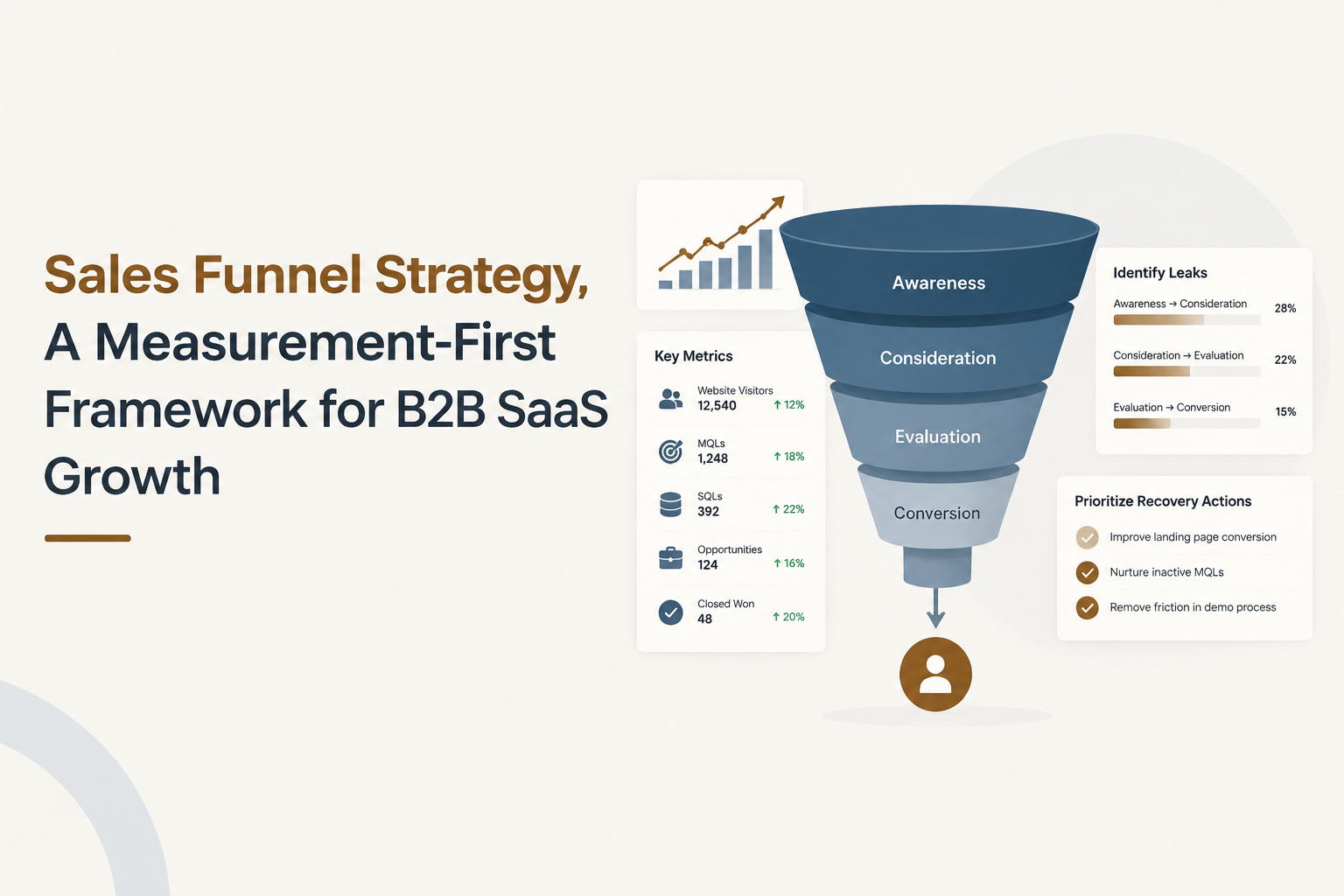
Measure Sales Funnel Leaks With Worked SaaS Conversion Math
Conversion math identifies the most valuable leak by showing how many prospects survive each step and how much revenue depends on improving that step.
Worked example
Assume a quarterly cohort of 10,000 targeted visitors produces 500 leads, 150 qualified leads, 45 opportunities, and 9 new customers. The stage conversions are:
- Visitor to lead: 500 divided by 10,000 = 5%.
- Lead to qualified lead: 150 divided by 500 = 30%.
- Qualified lead to opportunity: 45 divided by 150 = 30%.
- Opportunity to customer: 9 divided by 45 = 20%.
- Visitor to customer: 9 divided by 10,000 = 0.09%.
If average first-year revenue is $12,000, the cohort produces $108,000 in new revenue. If acquisition and demand-generation spend is $30,000, simple customer acquisition cost is $3,333 per customer, while revenue-to-spend is 3.6 to 1. These figures are illustrative planning math, so a real team should replace them with its own cohort data, gross margin, payback period, and sales costs.
The highest-impact recovery opportunity depends on both volume and economics. Raising opportunity-to-customer conversion from 20% to 25% would turn 45 opportunities into 11.25 expected customers, adding roughly 2.25 customers and $27,000 in first-year revenue at the stated average. Raising visitor-to-lead conversion from 5% to 6% would add 100 leads, but the resulting revenue depends on whether those extra leads match the same downstream quality.
Use cohort-based conversion funnel analysis to compare source, segment, month, and sales owner. Always pair a rate with its population, time window, and definition. Otherwise, a higher percentage may simply reflect a smaller or more selective sample.
Extend the Funnel Into Activation, Retention, and Advocacy
A complete sales funnel strategy continues after purchase by measuring whether customers reach value, repeat the value action, expand usage, and recommend the product.
Use a lifecycle loop
- Activation: Define the first action that proves initial value, such as completing setup or using a core workflow.
- Adoption: Track repeated use and the discovery of features associated with successful accounts.
- Retention: Compare active cohorts over time and flag declining frequency, reduced breadth, or missing key actions.
- Expansion: Identify accounts with growing usage, additional teams, or new use cases, then coordinate a relevant conversation.
- Advocacy: Ask for referrals, reviews, or case-study participation only after the customer has demonstrated value.
Activation should be treated as a measurable transition, not a welcome email. Define the event sequence, time window, and responsible team. If an account signs up but never completes the value action, the recovery path may be an onboarding prompt, guided session, educational email, or direct support.
Retention analysis also benefits from behavioral segmentation. Compare power users, newly activated accounts, inactive accounts, and customers approaching renewal. The goal is not to create dozens of audiences; it is to connect a meaningful behavior pattern to a specific intervention and then measure the response.
Review the full loop monthly, but inspect early activation and high-intent purchase activity weekly. That cadence balances short-term execution with enough time for retention signals to become meaningful. The result is a system that improves both acquisition efficiency and customer value instead of treating the first payment as the finish line.
Sales Funnel Strategy FAQ
Once the framework is defined, Founder OS can help you start tracking funnel events, connect behavior to user profiles, segment audiences, and review GTM performance in one place. Use it to validate your criteria with real product activity and improve the next stage of your growth process.

Written by Anthony Do
Business Development Specialist at FounderOS, helping SaaS founders grow with product analytics and user activation.

Onboarding Softwares for SaaS - The Shortlist and Buyer Scorecard for In-App Flows
Compare onboarding softwares for SaaS in-app tours and flows using a buyer scorecard, shortlist, pricing notes, and a 14-day rollout plan.
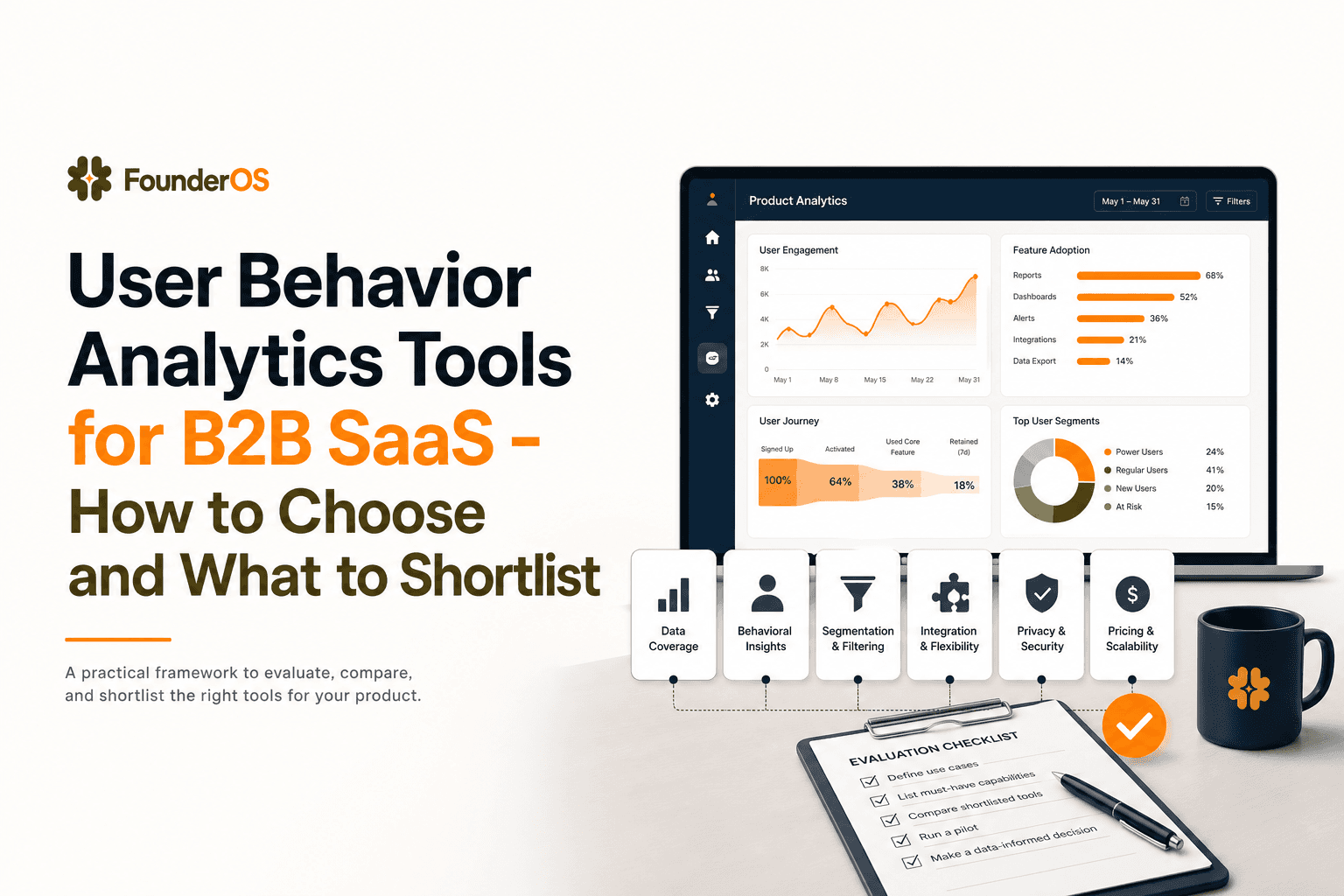
User Behavior Analytics Tools for B2B SaaS - How to Choose and What to Shortlist
Learn how to shortlist user behavior analytics tools for B2B SaaS using criteria tied to activation, funnels, and revenue outcomes.

Website Analytic Software, A SaaS Growth Team’s Framework For Choosing The Right Platform
Choose website analytic software with a SaaS framework for tracking users, conversions, retention, revenue signals, and growth decisions.