
Stages In Sales Funnel Explained, One Master Map For 3, 5, 6, And 7 Stages
Stages in sales funnel are the checkpoints a buyer passes through from first awareness to purchase, and stage clarity matters because it makes handoffs and measurement consistent across teams.
- Use one master map to translate 3-, 5-, 6-, and 7-stage models into the same buyer checkpoints.
- Define each stage with entry and exit criteria plus one primary asset or action.
- Measure stage health with a minimal KPI set: conversion rate, time-in-stage, and stage volume.
What “Stages In A Sales Funnel” Means And Why Stage Clarity Matters
Stages in sales funnel work only when each stage matches a specific buyer intent and a measurable signal that progress happened.
What a “stage” is in practice
A stage is a shared definition of three things: (1) what the buyer is trying to accomplish right now, (2) what observable signal proves they are in that moment, and (3) what signal proves they moved forward. Without those definitions, teams end up using stage names as opinions, not as operating rules.
What breaks when stages are fuzzy
- Handoffs become arguments: marketing says “qualified,” sales says “not ready,” and there is no objective rule to settle it.
- Reporting becomes misleading: a stage looks healthy because entry criteria are too loose, not because buyers are moving.
- Experiments stop being diagnosable: you change one page or email, but you measure impact inside a stage that includes multiple intents.
In our experience working with B2B SaaS teams, the most common root cause is combining multiple intents into one catch-all stage (for example, mixing “learning” behaviors with “buying” behaviors), then expecting conversion math to stay meaningful.
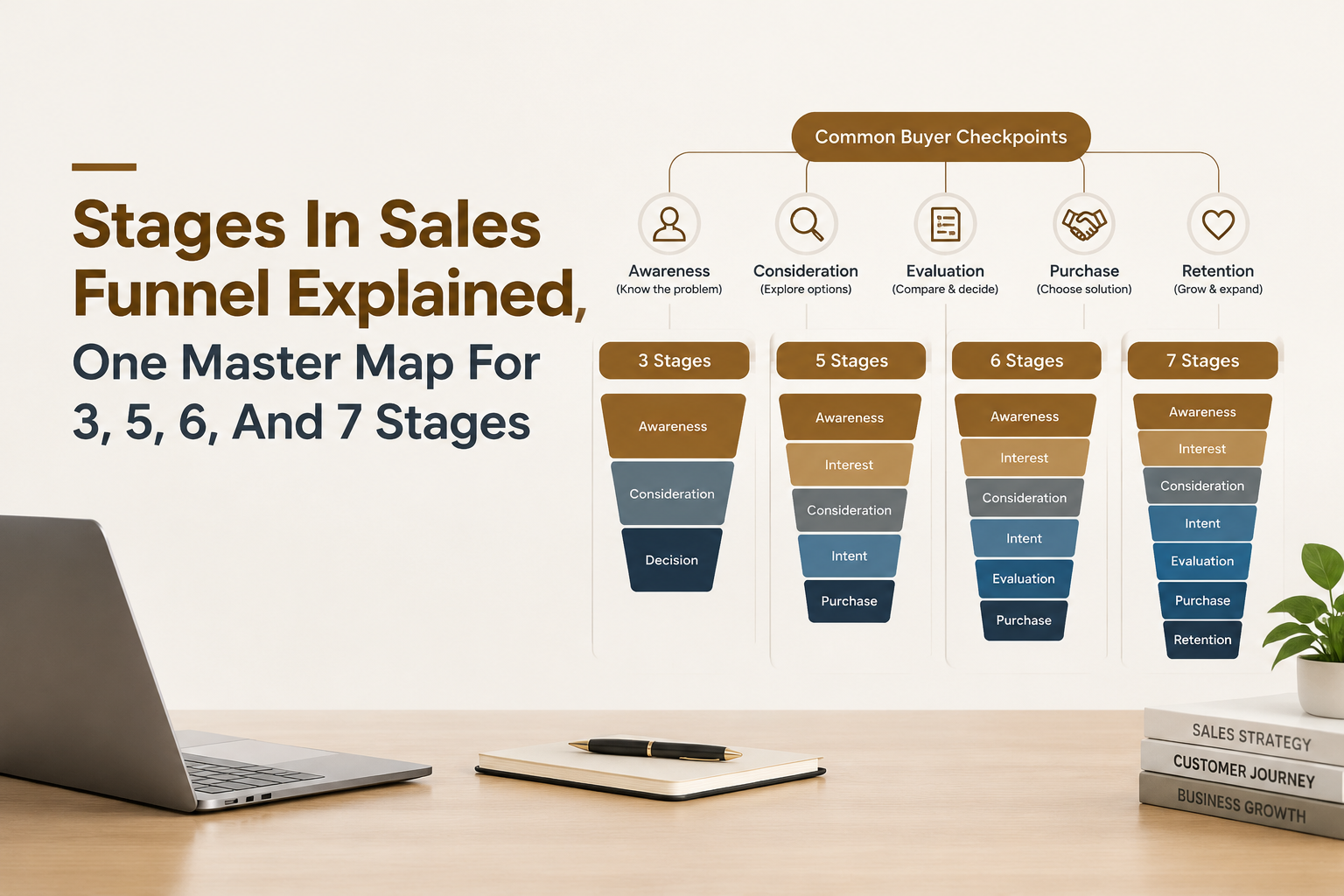
The Master Map That Reconciles 3, 5, 6, And 7 Sales Funnel Stage Models
The most reliable way to reconcile different stage models is to map them to the same buyer checkpoints, then decide how much detail you need.
The master map in six checkpoints
Across most businesses, the buyer’s journey can be described as: Awareness → Engagement → Lead Capture → Qualification → Evaluation → Purchase. Some models compress these, and some split them into more detail, but the underlying progression is similar.
Comparison table you can use to translate stage models
| Master checkpoint | 3-stage model often calls it | 5-stage model often calls it | 6-7 stage models often split it into | When you should split it |
|---|---|---|---|---|
| Awareness | Top | Awareness | Problem aware vs solution aware | If you run different messages for “problem” vs “solution” content |
| Engagement | Top | Interest | Content engaged vs product engaged | If demos/trials drive outcomes and you need to separate them from content |
| Lead Capture | Top | Consideration | Subscriber, lead, inbound request | If your sales team only works with captured leads, not anonymous traffic |
| Qualification | Middle | Intent | Marketing-qualified vs sales-accepted vs sales-qualified | If handoffs between teams are a bottleneck |
| Evaluation | Middle | Evaluation | Discovery, demo, trial, proposal, security review | If your buying cycle has multiple commitments and you need to see where deals stall |
| Purchase | Bottom | Purchase | Negotiation, close, payment, onboarding kickoff | If pricing/terms or procurement regularly delay close |
How to choose the right level of detail
- Start with fewer stages if: you are early, volume is low, and you need direction more than precision.
- Add detail when: you see repeated stalls that you cannot locate (for example, deals “stuck in evaluation” for weeks).
- Keep stage count stable for reporting: if you change stage definitions weekly, trend lines lose meaning.
Stages In The Sales Funnel With Examples, Two Walkthroughs You Can Reuse
Stages in sales funnel become easy to operationalize when each stage includes a buyer mindset, a primary asset or interaction, and a success signal.
Walkthrough A: B2B SaaS (sales-assisted)
| Stage | Buyer mindset | Typical asset or interaction | Success signal (exit) |
|---|---|---|---|
| Awareness | “I have a problem, not sure what to do.” | Category content, benchmarks, pain-point landing page | Returns to site or views solution pages |
| Engagement | “I’m learning options and tradeoffs.” | Webinar, comparison guide, product overview page | High-intent page depth or pricing page view |
| Lead Capture | “I want something specific.” | Newsletter signup, template download, request form | Verified email captured |
| Qualification | “Is this worth talking about now?” | Inbound SDR call, qualifying questions, routing | Meeting booked with the right stakeholder |
| Evaluation | “Prove it works for us.” | Discovery, demo, trial, security review | Mutual plan and decision date agreed |
| Purchase | “Make it official.” | Proposal, negotiation, signature, payment | Contract signed or first payment received |
Walkthrough B: B2C digital product (self-serve)
| Stage | User mindset | Typical asset or interaction | Success signal (exit) |
|---|---|---|---|
| Awareness | “This looks relevant.” | Short video, influencer post, app store listing | Installs or visits landing page |
| Engagement | “Let me see if it fits.” | Feature page, onboarding preview, social proof | Creates account |
| Lead Capture | “I’ll try it.” | Email signup or phone verification | Verified account |
| Qualification | “Do I have enough value to continue?” | Onboarding checklist, first-use guidance | Completes first key action |
| Evaluation | “Should I pay?” | Paywall, trial limits, upgrade prompts | Starts checkout |
| Purchase | “Done.” | Payment confirmation | Subscription active |
What surprised our team was how often “Qualification” in self-serve is not about firmographics, but about whether the user reached a first meaningful moment of value; treating that as its own stage made fixes much more targeted.
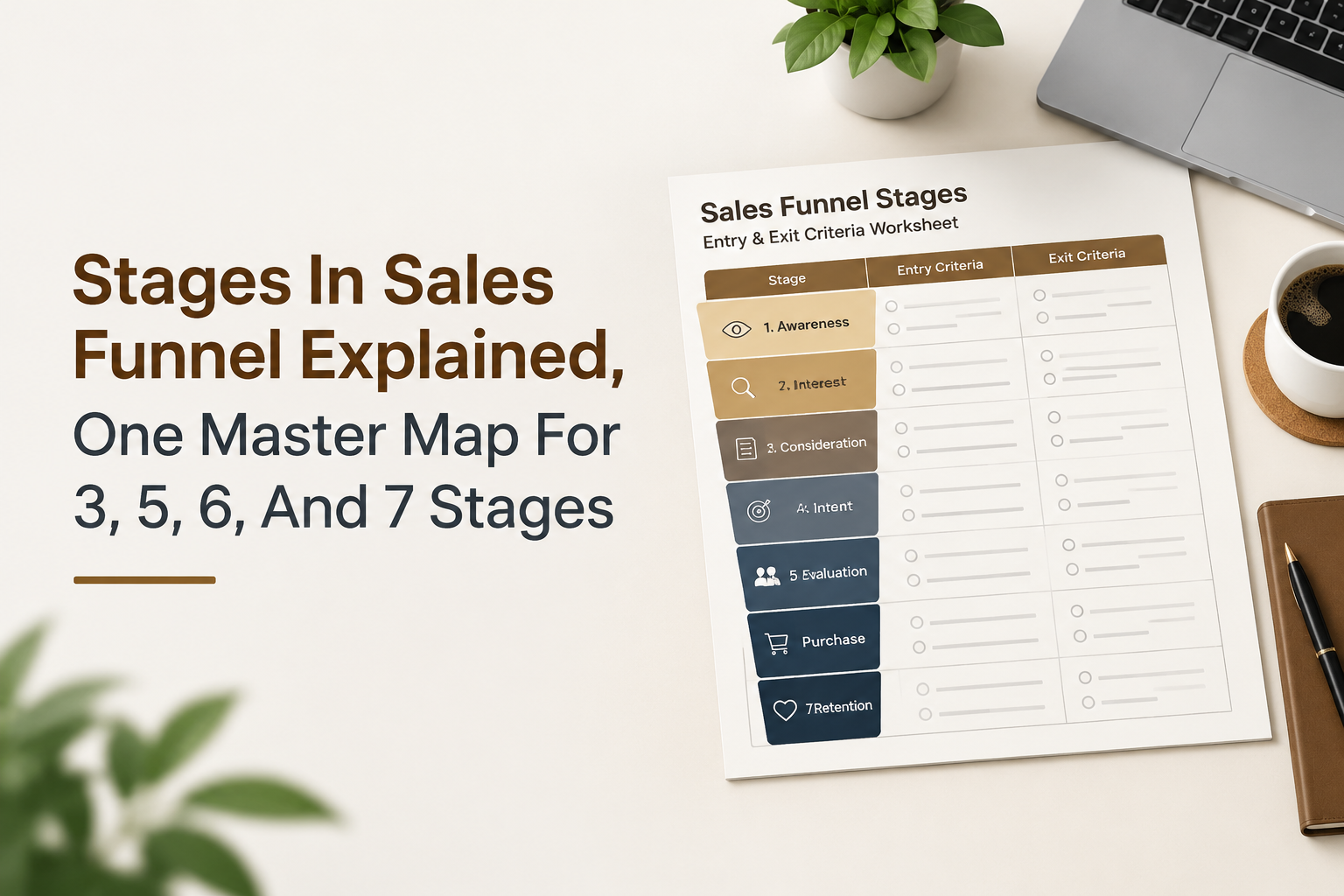
A Copy-Paste Sales Funnel Stages Template With Entry Exit Criteria And Assets
A usable stages worksheet fits on one page and forces a team to agree on entry, exit, owner, and the primary asset for each stage.
Copy-paste worksheet
| Stage | Owner | Entry criteria (must be observable) | Exit criteria (must be observable) | Primary asset or action | If they stall, do this |
|---|---|---|---|---|---|
| Awareness | Marketing | First visit from a tracked source | Second visit OR solution page view | Pain-point page + category guide | Retarget to “problem” content |
| Engagement | Marketing | Consumes 2+ assets OR high-intent page view | Lead captured (form) OR product interaction | Comparison guide, webinar, product tour | Nurture sequence to a single next step |
| Lead Capture | Marketing / RevOps | Email submitted and verified | Routed to sales OR enters self-serve onboarding | Template, checklist, request form | Follow-up within defined SLA |
| Qualification | Sales | Lead routed and contacted | Meeting booked OR disqualified with reason | Qual call, routing rules | Recycle to nurture with reason tag |
| Evaluation | Sales | Discovery completed | Proposal sent OR decision date set | Demo, trial, security pack | Mutual action plan, unblock procurement |
| Purchase | Sales | Proposal accepted in principle | Signed + paid (or signed + invoice issued) | Order form, contract, payment | Escalate blockers and timeline |
Two rules that make the template actually work
- Use events, not opinions: “Interested” is not an entry criterion; “viewed pricing” or “requested demo” is.
- Allow exit to “disqualified”: a clean “no” is progress for forecasting and for learning.
How To Measure Each Funnel Stage, Minimal KPIs And Simple Formulas
The minimal measurement set for stages in sales funnel is stage volume, stage-to-stage conversion rate, and time-in-stage, reviewed on a fixed cadence.
Stage KPI matrix (minimal set)
| Stage | Volume (count) | Primary conversion rate | Time-in-stage (median) | What “bad” usually means |
|---|---|---|---|---|
| Awareness | Unique visitors | Engagement rate = Engaged / Visitors | Days to engagement | Mismatch in targeting or message |
| Engagement | Engaged visitors | Lead capture rate = Leads / Engaged | Days to lead capture | Weak offer, unclear next step |
| Lead Capture | New leads | Qualification rate = Qualified / Leads | Hours to first response | Slow follow-up or poor routing |
| Qualification | Contacted leads | Meeting set rate = Meetings / Contacted | Days to meeting | Bad fit or weak outreach |
| Evaluation | Active opportunities | Win rate = Wins / Opportunities | Sales cycle length | Unclear value, missing stakeholders, procurement friction |
| Purchase | Proposals | Close rate = Closed / Proposals | Days from proposal to close | Pricing/terms misalignment |
Simple formulas (copy into a spreadsheet)
- Stage-to-stage conversion: (Exited to next stage) / (Entered stage)
- Time-in-stage: Median(exit date - entry date)
- Weekly stage movement: Entries, Exits forward, Exits disqualified, Ending in-stage
A weekly report layout that avoids vanity metrics
- One line per stage: starting count, entries, exits forward, exits disqualified, ending count
- Two trend lines: conversion rate and median time-in-stage
- One note per stage: “what changed this week” tied to a specific asset or process change
After running several stage audits, the pattern was clear: conversion rate alone hides problems when volume swings, so pairing conversion with time-in-stage catches slowdowns before revenue forecasts drift.
Common Questions, Sales Funnel Vs Pipeline, Retention As A Stage, And The 3-3-3 Rule
Most confusion about stages in sales funnel comes from mixing a buyer journey view with an internal deal management view, plus disagreement about where “after purchase” belongs.
Sales funnel vs pipeline: what is different
- Funnel stages: describe buyer progress and conversion from one checkpoint to the next.
- Pipeline stages: describe internal deal steps and forecast categories (what your team is doing).
A practical rule is to align them, but not force them to be identical. For example, your internal step “security review sent” might live inside the buyer checkpoint “Evaluation.”
Should retention be a stage
Retention is best tracked as a separate lifecycle after purchase because the success signals and owners change. If you keep it in the same model, label it explicitly as “Post-purchase value confirmed” so it does not get mixed into acquisition conversion rates.
The 3-3-3 rule for stage design
- 3 buyer checkpoints: awareness, evaluation, purchase (the minimum viable model).
- 3 operational add-ons: engagement, lead capture, qualification (common in SaaS).
- 3 measures per stage: volume, conversion, time (the minimal KPI set).
| If your problem is... | Most likely fix is... | Stage to inspect first |
|---|---|---|
| High traffic, low leads | Clarify offer and next step | Engagement |
| Many leads, few meetings | Tighten routing and qualification criteria | Qualification |
| Lots of demos, slow closes | Split evaluation sub-steps and track stall points | Evaluation |
FAQ
If you want a simple way to track stage entry and exit events from real user behavior and keep your worksheet up to date, Founder OS can help by capturing product and website actions, tying them to user profiles, and turning them into clear stage movement reports; you can start with a free worksheet and then decide whether event-based tracking is worth adding.
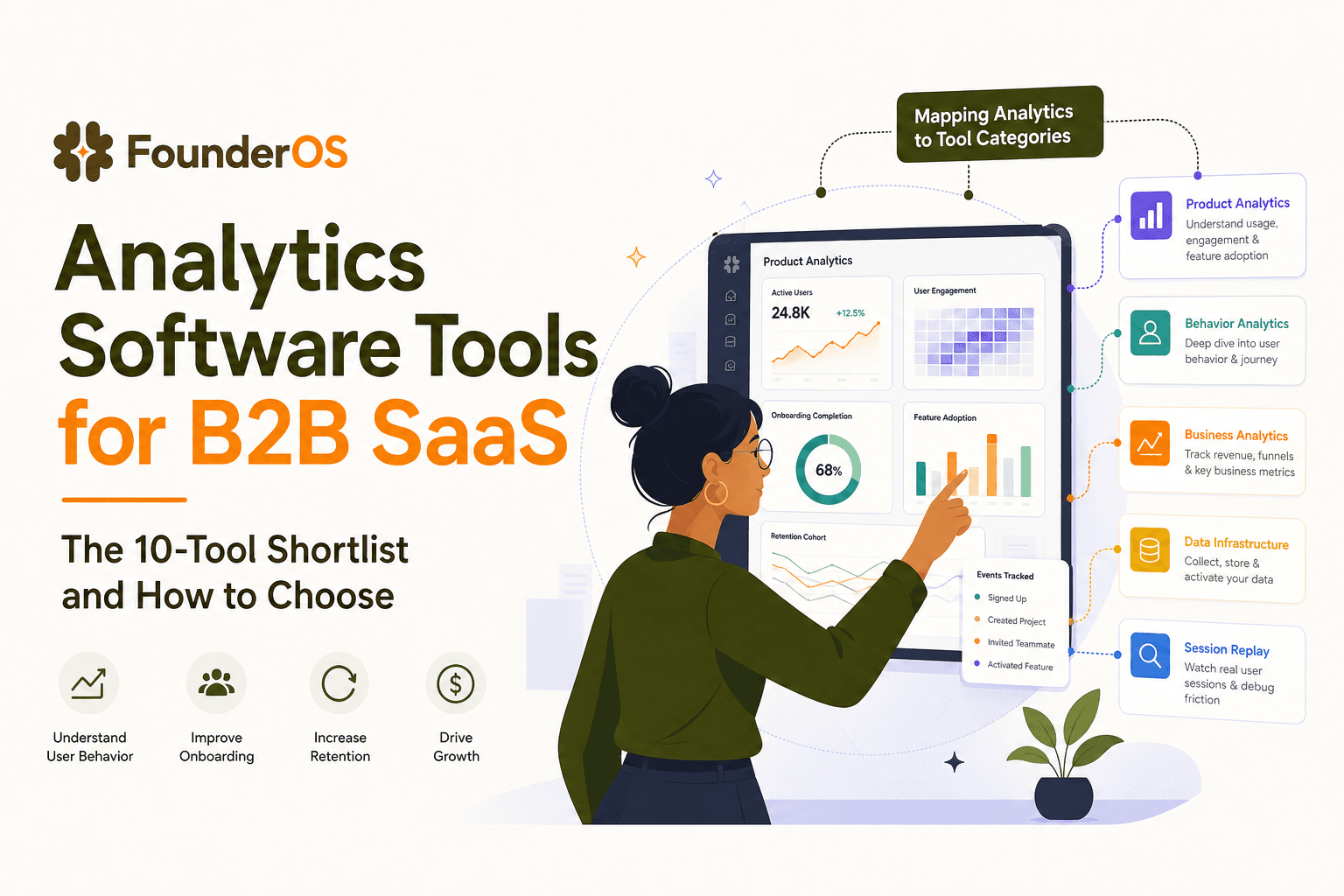
Analytics Software Tools for B2B SaaS - The 10-Tool Shortlist and How to Choose
A BOFU-ready shortlist of analytics software tools for B2B SaaS: 10 picks across categories plus a buyer rubric and rollout plan.

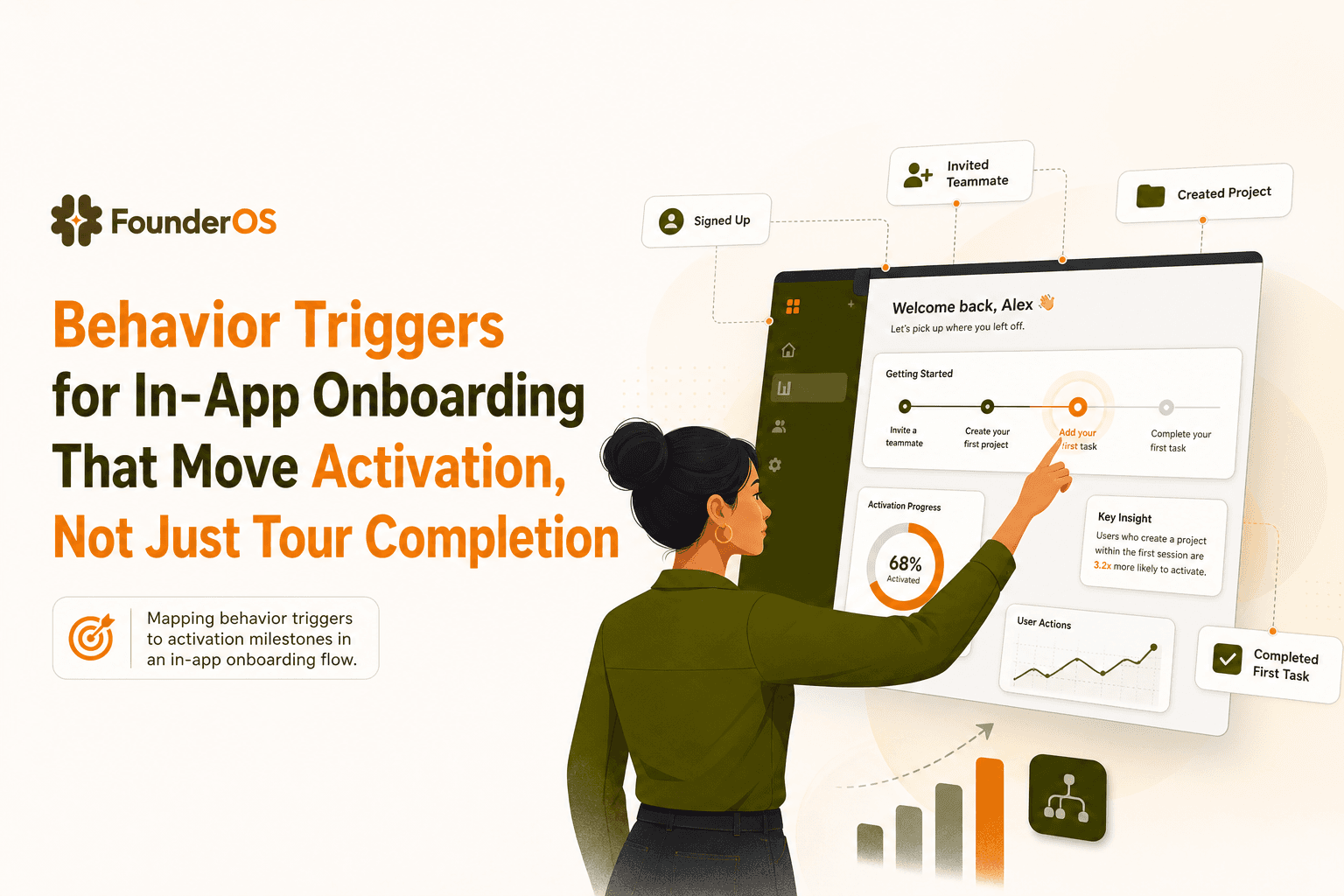
Behavior Triggers for In-App Onboarding That Move Activation, Not Just Tour Completion
Learn behavior triggers for in-app onboarding that drive activation milestones, not just tour completion. Includes trigger taxonomy, tests, and checklists.
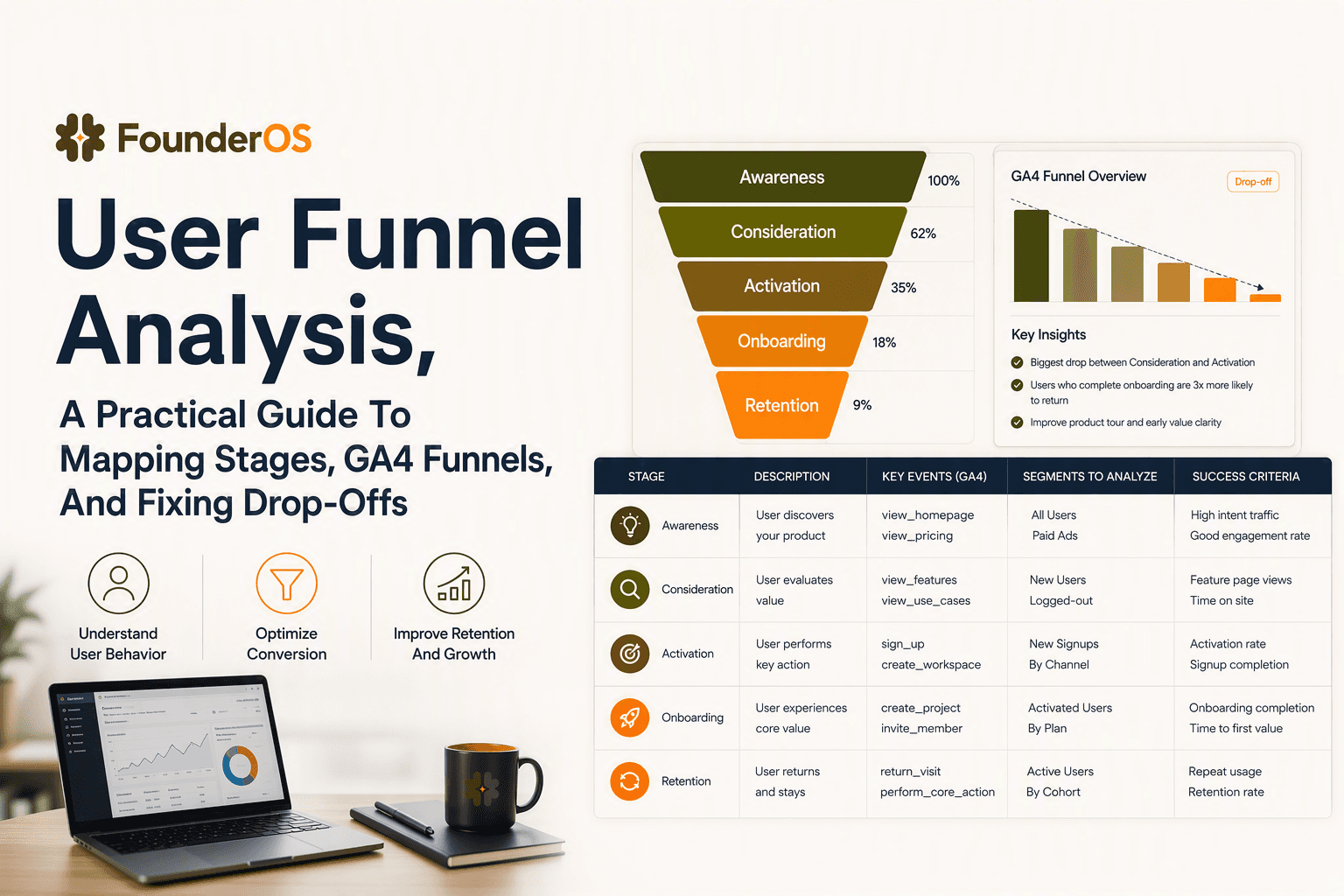
User Funnel Analysis, A Practical Guide To Mapping Stages, GA4 Funnels, And Fixing Drop-Offs
Learn user funnel planning, GA4 funnel exploration, SQL patterns, and how to turn drop-offs into experiments and fixes.