
Building Sales Funnels for B2B SaaS, A Simple 5-Stage Model and Free Template
Learn building sales funnels for B2B SaaS with a simple five-stage model, free setup, KPI formulas, tracking plan, and copyable examples.

Building sales funnels for B2B SaaS becomes easier when every prospect action has a defined stage, owner, and next step. This guide uses one five-stage model mapped to AIDA and common pipeline statuses, then turns it into a free 60-minute setup with measurable events and practical templates.
- A useful B2B SaaS sales funnel connects attention, evaluation, decision, purchase, and adoption to clear exit criteria.
- A free landing page, form, spreadsheet, email tool, and event checklist are enough to measure an initial funnel.
- Stage conversion rate, time to next step, activation, and revenue provide a practical KPI map without advanced math.
What a B2B SaaS Sales Funnel Measures
A B2B SaaS sales funnel measures how people move from first relevant interaction to a paying, activated account. The funnel is a measurement model, not a department or software feature. A marketing funnel usually describes reach and demand, while a sales pipeline tracks named opportunities and their expected revenue. A sales funnel connects both views through observable actions.
Consider a simple journey: a founder visits a product page, downloads a checklist, books a call, starts a trial, and invites a teammate. Each action answers a different question:
- Attention: Did the right audience notice the offer?
- Interest: Did visitors exchange contact details or request useful information?
- Evaluation: Did a qualified account take a product or sales action?
- Decision: Did the account accept a commercial next step?
- Adoption: Did the customer reach the value moment that supports retention?
The purpose of building sales funnels is to locate the largest controllable gap. A low visit-to-lead rate points to message, audience, or page friction. A healthy lead rate but weak meeting rate points to qualification or follow-up. Strong bookings but poor activation indicate a handoff problem after the sale.
Define one primary conversion before adding secondary metrics. For a self-serve product, the primary conversion might be an activated trial. For a sales-assisted product, it might be a qualified opportunity or closed-won account. Secondary actions, such as content downloads, should explain movement toward that outcome rather than compete with it.
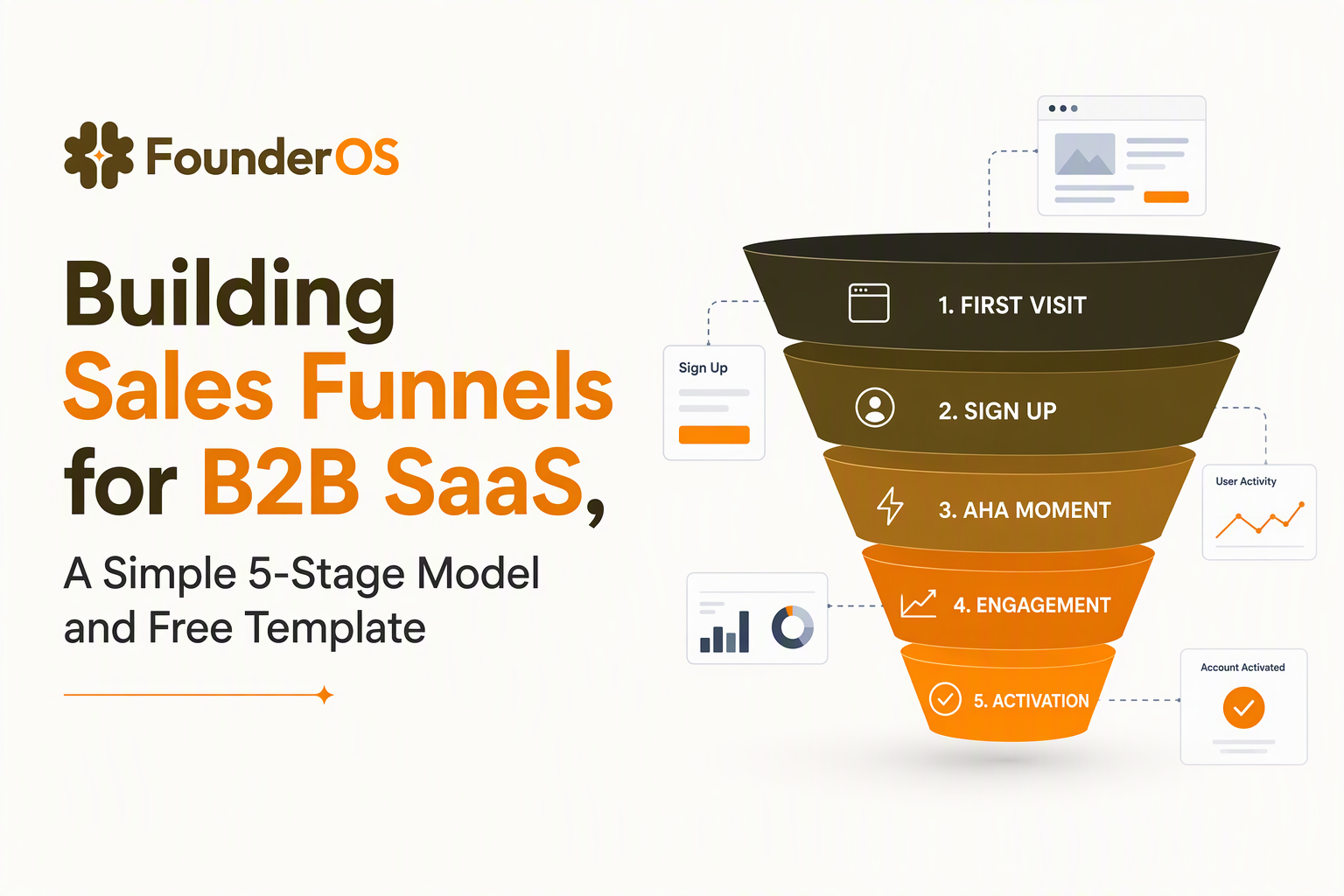
The Five Sales Funnel Stages Mapped to AIDA and Pipeline Status
A five-stage model removes confusion by assigning one goal and one exit condition to each point in the buyer journey. AIDA supplies the communication logic, while pipeline statuses supply the operational view.
| Stage | AIDA link | Pipeline status | Goal | Exit criterion |
|---|---|---|---|---|
| 1. Attract | Attention | New visitor | Earn a relevant visit | Visitor views the intended page or asset |
| 2. Capture | Interest | New lead | Start a permission-based conversation | Lead submits a form or requests contact |
| 3. Qualify | Interest and desire | Marketing or sales qualified lead | Confirm fit, need, and timing | Lead meets documented qualification rules |
| 4. Convert | Desire and action | Opportunity or customer | Secure a commercial commitment | Payment, signed agreement, or accepted order |
| 5. Activate | Post-purchase action | Adopted customer | Reach the first meaningful product outcome | Customer completes the defined value event |
Keep the model stable even when campaigns change. A webinar, product-led trial, and sales demo can have different assets, but each should still map to these five outcomes. The practical rule is simple: a stage changes only when the exit criterion is recorded, not when a team member feels that a lead is “warm.”
In our experience working with early B2B SaaS teams, the biggest reporting error is treating a form submission as a sales opportunity. A form shows interest; qualification requires evidence of customer fit, problem relevance, and a plausible next action.
How to Build a Sales Funnel From Offer to Follow-Up
Building sales funnels works best as a sequence of six decisions, completed before buying new software or producing a large content library.
1. Choose the audience and problem
Write one sentence containing the target account, painful job, and promised outcome. For example: “B2B SaaS founders who cannot explain trial drop-off get a simple activation report within one working session.” Reject messages that target several roles or promise unrelated outcomes.
2. Select one conversion path
Choose demo-led, trial-led, or education-led motion. A demo-led path needs a booking page and qualification questions. A trial-led path needs signup, onboarding, and activation events. An education-led path needs a useful asset and a defined follow-up invitation. Do not ask one page to optimize for all three.
3. Create one asset per stage
- Attract: Search article, partner mention, or social post tied to the problem.
- Capture: Landing page with one promise, proof, form, and next step.
- Qualify: Short form or discovery script covering company type, problem, urgency, and current process.
- Convert: Demo agenda, proposal, pricing explanation, and objection answers.
- Activate: First-session checklist and a measurable value event.
4. Assign owners and service levels
The marketing owner maintains the page and acquisition source. The sales owner reviews new qualified leads and records outcomes. The product or customer success owner defines activation and monitors early usage. Set a response rule, such as reviewing every new high-fit lead during the next business block, then record whether the rule was followed.
5. Write follow-up before launch
Prepare three messages: immediate delivery, useful guidance, and a direct next-step invitation. Each message should answer one likely objection. For example, a tracking guide can explain setup effort, while a demo email can clarify who should attend and what will be covered.
6. Review weekly using decisions, not impressions
Record volume, conversion, time between stages, and reasons for loss. Keep a short change log so the team knows which page, message, or qualification rule changed and when. This makes building sales funnels an operating process rather than a one-time campaign.
How to Build a Sales Funnel for Free in 60 Minutes
A functional zero-cost sales funnel can be assembled in one hour with a page builder, free form, spreadsheet, email sender, calendar link, and basic analytics.
- Minutes 0 to 10, define the path: Write the audience, problem, primary conversion, and activation event. Example: visitor, form lead, qualified call, trial, invited teammate.
- Minutes 10 to 25, publish the page: Use one headline, three benefit bullets, one proof point, one form, and one call to action. Remove navigation links that lead away from the intended action.
- Minutes 25 to 35, connect the form: Send submissions to a spreadsheet with fields for source, company, role, problem, status, next step, and outcome.
- Minutes 35 to 45, write follow-up: Create an immediate confirmation, a problem-solving email, and a calendar invitation. Add a manual reminder for leads requiring personal outreach.
- Minutes 45 to 55, add tracking: Use consistent campaign tags and record page view, form start, form submit, booking, signup, and activation.
- Minutes 55 to 60, test the journey: Submit the form yourself, confirm the spreadsheet row, check the email, open the calendar link, and verify every event has a timestamp.
The $0 setup has limits. It may require manual updates, cannot reliably join every product action to a person, and becomes difficult to segment as volume grows. Those limits are acceptable for validating the offer. The goal is not perfect infrastructure; it is enough evidence to decide what deserves investment.
When we tested a manual spreadsheet workflow, the most valuable improvement was not another dashboard. It was adding a required “next step and date” column, which exposed stalled leads that headline-level conversion reports hid.
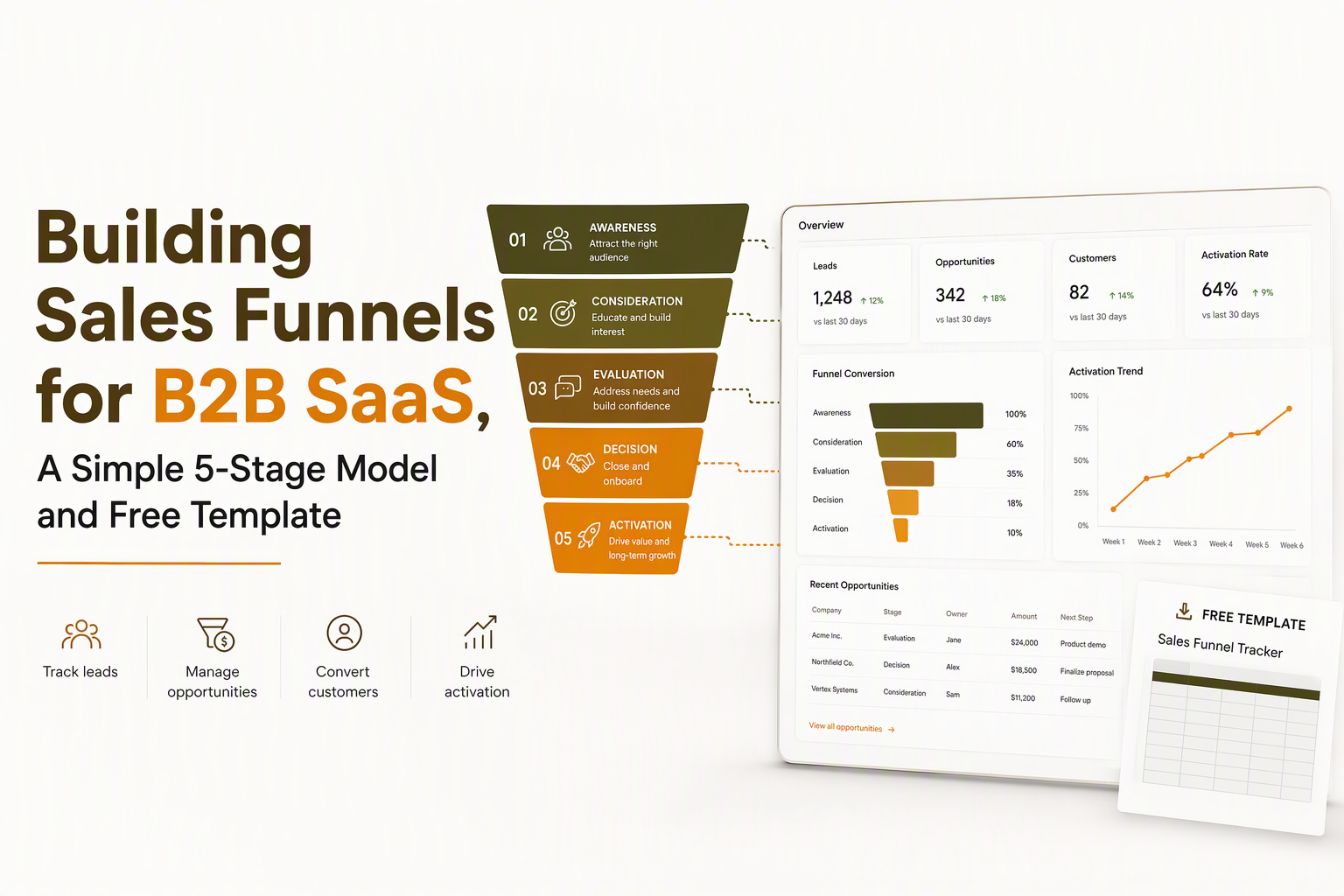
How to Measure a Sales Funnel With KPIs and Events
A useful KPI map assigns one rate, one speed measure, and one quality signal to each stage. Use the same definitions every week.
| Stage | Primary KPI | Formula | Events to track |
|---|---|---|---|
| Attract | Visitor-to-lead rate | Leads divided by unique visitors | page_view, campaign_visit |
| Capture | Form completion rate | Form submissions divided by form starts | form_start, form_submit |
| Qualify | Lead qualification rate | Qualified leads divided by total leads | lead_created, lead_qualified |
| Convert | Opportunity-to-customer rate | Customers divided by opportunities | proposal_sent, purchase |
| Activate | Activation rate | Activated customers divided by new customers | signup, core_action, teammate_invited |
Use a worked example to prevent vague reporting. Suppose 1,000 people visit a page, 80 submit a form, 24 qualify, 8 become opportunities, 3 purchase, and 2 activate. The rates are 8% visitor-to-lead, 30% lead-to-qualified, 33.3% qualified-to-opportunity, 37.5% opportunity-to-customer, and 66.7% customer-to-activation. The overall visitor-to-customer rate is 0.3%.
Track events with a consistent naming plan. Each event should include an actor identifier, timestamp, account identifier when available, source, and relevant properties such as plan or role. Avoid collecting sensitive data that is not needed for the decision. A small, reliable plan is better than dozens of events nobody reviews. For broader implementation guidance, see analytics events tracking and conversion funnel analysis.
Review rates by source, company type, plan, and signup month when the data supports it. A blended average can hide a channel that produces many leads but few activated customers. Add revenue only after customer and account identifiers are consistent, then compare revenue by source and qualified segment.
Sales Funnel Templates and Examples You Can Copy
A copyable worksheet should contain six columns: stage, customer action, asset, owner, exit criterion, and event name. Add source, date, status, next step, and loss reason for each lead or account.
Example one: demo-led analytics software
Path: Search article to demo request to qualified call to proposal to signed agreement. Primary goal: qualified opportunities. Activation event: the buyer connects a data source and reviews a first report. The owner of qualification records company size, current reporting method, urgent problem, and buying window before advancing the opportunity.
Example two: product-led collaboration tool
Path: Comparison page to free signup to workspace creation to teammate invitation to paid plan. Primary goal: activated accounts. Activation event: a workspace completes its core collaboration action with at least one invited teammate. The product owner reviews signup-to-activation loss by acquisition source and role.
Example three: founder education offer
Path: Practical article to template download to email reply to workshop booking to consulting engagement. Primary goal: qualified conversations. Activation event: the prospect completes the worksheet and identifies a measurable business problem. The marketing owner tags the source and the sales owner records the problem category.
Use the worksheet to choose one improvement each week. If form completion is weak, simplify the form. If qualification is weak, refine the audience or promise. If activation is weak, improve onboarding or clarify the first value event. For acquisition quality, pair the worksheet with revenue attribution once account-level data is dependable.
After running several funnel audits, our team found that the most actionable finding was usually a missing exit criterion, not a missing metric. Once each stage had a recorded next action, owners could test changes without arguing over definitions.
Frequently Asked Questions About Building Sales Funnels
What is the simplest B2B SaaS sales funnel?
The simplest model is visitor, lead, qualified conversation, customer, and activated customer. Each step needs one event and one exit criterion.
How many stages should a sales funnel have?
Five stages are enough for a starter B2B SaaS model because they separate acquisition, capture, qualification, purchase, and adoption without excessive reporting complexity.
What should a new team measure first?
Measure unique visitors, leads, qualified leads, customers, activated customers, and the conversion rate between each adjacent step. Add speed and revenue after definitions are stable.
When should a company move beyond free tools?
Move when manual reconciliation prevents reliable reporting, user-level behavior matters, or segmentation and account-level revenue analysis require more consistent data.
When your free setup starts hiding important user behavior, Founder OS can help you apply the same KPI map through lightweight product analytics, user profiles, segmentation, conversion funnels, and growth reporting. Use the checklist first, then start free or book a demo when your team needs connected visibility.
Read Next
View all
Guided Product Tour Blueprint to Ship a Measurable Activation Flow in 72 Hours
A guided product tour blueprint to ship in 72 hours: define the promise, map steps to events, segment entry rules, and measure activation.

User Onboarding SaaS Explained, A Reusable Blueprint and Checklist
Learn user onboarding saas with a practical blueprint: stages, UI patterns, checklist, and a simple measurement plan to improve activation.
Product Adoption Platform Buyer Guide - Validate the Right Tool in 7 Days
Use this 7-day plan to validate a product adoption platform with activation metrics, instrumentation, and a minimum viable onboarding flow.