
Product Adoption Platform Buyer Guide - Validate the Right Tool in 7 Days
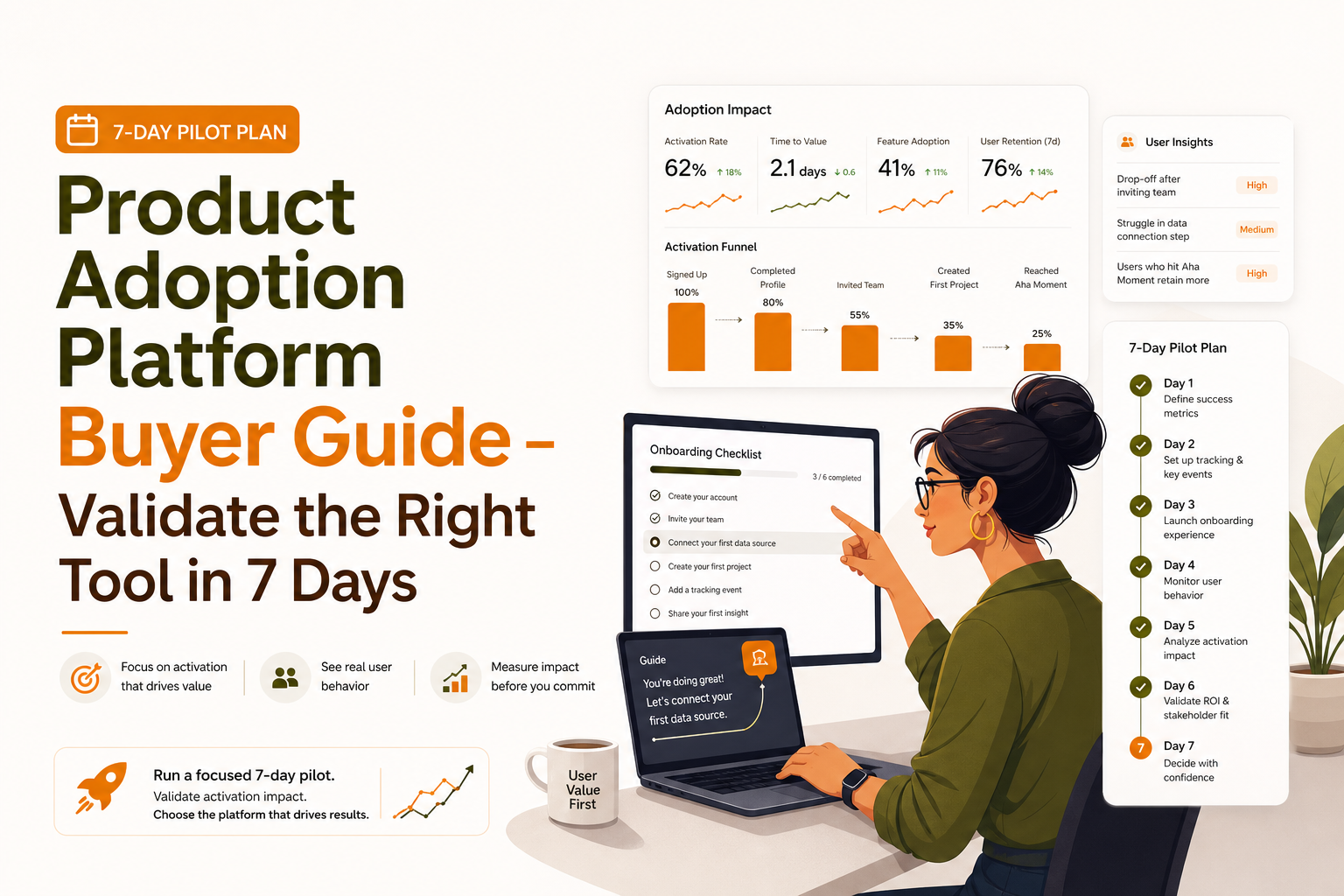
Choosing a product adoption platform should not take a quarter of debates about tours versus outcomes. You can validate the right tool in 7 days by running a controlled pilot: one persona, one activation goal, one minimum viable onboarding flow, and instrumentation that proves behavior change (not just “tour views”).
- Whether a product adoption platform can measurably lift activation and shorten time-to-value for one core persona.
- Whether targeting, segmentation, and instrumentation are strong enough to scale beyond a single tour.
- Whether your team can ship, QA, and govern onboarding changes without engineering becoming a bottleneck.
The agitation - why a product adoption platform decision is costing you money, time, and reputation
If your onboarding and in-app guidance are not measurably improving activation, you are paying for growth twice: once to acquire signups, and again to replace the ones who churn before they ever reach an “aha” moment. The cost of inaction compounds because onboarding is upstream of everything: retention, expansion, support load, and even your sales team’s credibility when they promise “fast time-to-value.”
Cost bucket 1 - wasted acquisition spend and lower conversion efficiency
When new users stall, you do not just lose them. You distort your entire acquisition model. CAC payback assumptions break because activation is the bridge between “signup” and “value.” If activation is flat, the only lever left is more spend, which is the least capital-efficient option.
- Symptom: high signup volume, low “first key action” completion.
- Hidden cost: marketing tests look inconclusive because downstream behavior is noisy.
- What to measure: activation rate for a single persona and use case, not overall DAU.
Cost bucket 2 - support tickets that should have been prevented
Every “How do I…?” ticket is both a cost and a signal that the product is not self-serve at the moment it matters. If you ship features quickly but do not ship guidance and discovery at the same pace, support becomes the default onboarding system.
- Symptom: repetitive tickets tied to the same 3 to 5 UI areas.
- Hidden cost: support and success teams become reactive, reducing time for proactive retention work.
- What to measure: ticket volume tagged to onboarding topics per 100 new accounts.
Cost bucket 3 - brand and trust erosion in high-value accounts
In B2B SaaS, buyers equate “hard to get started” with “hard to roll out internally.” If a champion cannot reach value quickly, they hesitate to invite teammates, and the deal momentum slows. That is a reputation problem, not just a UX problem.
- Symptom: champions ask for calls that should be unnecessary, or request “training” early.
- Hidden cost: sales cycles lengthen and expansion becomes harder.
- What to measure: time-to-first-value for the champion persona, plus invite rate within 7 days.
Do not start by building a “welcome tour.” Start by instrumenting the failure path. Identify the exact step where users abandon setup (for example, “connected data source,” “created first project,” or “invited teammate”), then build guidance only for that step. A product adoption platform that cannot target and measure a single high-friction step will not magically perform when you scale to 20 flows.
The strategic blueprint to overcome onboarding stalls and validate a product adoption platform
This is a 4-step methodology to validate any product adoption platform quickly. It is designed to produce a buying decision based on measurable behavior change, using a controlled pilot that you can complete in one week.
Step 1 - define Week 1 success criteria that are hard to game
Most pilots fail because they measure “engagement with the tour” instead of “activation in the product.” Your success criteria should include one primary metric and two guardrails:
- Primary: activation lift on a single activation event (for one persona).
- Guardrail 1: reduced time to value (median time from signup to activation event).
- Guardrail 2: no negative impact on core conversion steps (for example, trial to paid, or invite teammate).
Benchmark guidance: In a small pilot, a realistic target is a 10% to 20% relative lift on the activation event for the targeted cohort, with a measurable improvement in median time-to-value. If you cannot move a single metric in a controlled cohort, scaling is unlikely to help.
Step 2 - choose one persona and one use case, then write the activation-first scorecard
Scope is your advantage. Pick one persona (for example, “Ops Manager” or “Founder”) and one use case (for example, “create first dashboard”). Then create a scorecard that you will use to judge the platform, not the vendor demo.
- Persona clarity: can you target by role, plan, lifecycle stage, and key attributes?
- Behavior targeting: can you trigger flows based on specific events and event properties?
- Measurement: can you see step drop-off and downstream activation impact, not just completion?
- Speed: can a non-engineer ship changes in hours with QA and rollback?
Step 3 - design a minimum viable onboarding flow that removes one bottleneck
Your pilot flow should be small enough to ship in a day, but specific enough to change behavior. A good minimum viable onboarding flow has:
- One trigger: first visit to the relevant page or first time the user hits a dead end.
- 3 to 6 steps: each step maps to a user action, not a UI explanation.
- One exit condition: once the activation event happens, the flow stops.
- One feedback capture: a single-question survey at the end for qualitative signal.
If you need inspiration, start with a onboarding checklist that ties each step to a measurable outcome.
Step 4 - instrument the funnel from trigger to activation, then run a clean experiment
A product adoption platform pilot must include instrumentation requirements upfront. At minimum, you need:
- Events: trigger viewed, step shown, step action completed, flow completed, activation event completed.
- Properties: persona attributes (role, plan), segment flags, and page or feature context.
- Experiment design: a holdout cohort (even 10% is enough) to compare activation.
Use a simple A/B design: 90% sees the flow, 10% holdout does not. Compare activation rate and median time-to-value across the two cohorts over 3 to 5 days.
The 7-day validation plan to choose a product adoption platform
This day-by-day plan is built to prevent “pilot drift,” where teams keep adding flows and never reach a decision. The output at the end of Day 7 is a go or no-go based on your scorecard.
Day 1 - lock the persona, activation event, and baseline
- Pick one persona and one activation event (example: “created first project”).
- Pull baseline activation rate and baseline median time-to-value for the last 14 to 30 days.
- List the top 3 friction points from session notes, tickets, or onboarding call recordings.
Day 2 - define targeting rules and the holdout cohort
- Write targeting rules in plain English (role, plan, URL, and behavior conditions).
- Decide holdout size (10% to 20%).
- Decide the “stop condition” event that ends the flow.
Day 3 - build the minimum viable onboarding flow and QA it
- Build 3 to 6 steps that each require a user action.
- Include one guided product tour pattern that points to the next action, not a feature description.
- QA on staging or a test account: check triggers, exit conditions, and mobile responsiveness if relevant.
Day 4 - ship to production with governance rules
- Publish the flow to the target cohort only.
- Set ownership: who can edit, who can publish, who reviews copy.
- Document rollback steps (disable flow, revert targeting, remove survey).
Day 5 - monitor step drop-off and fix one bottleneck
- Check where users drop off: step 2 and step 3 are often the culprits.
- Make one change only (copy, step order, or trigger timing).
- Confirm that the holdout cohort remains untouched.
Day 6 - evaluate activation lift and time-to-value impact
- Compare activation rate: exposed cohort vs holdout.
- Compare median time-to-value and 75th percentile time-to-value.
- Check guardrails: no drop in trial conversion or invites.
Day 7 - make the buying decision using the activation-first scorecard
Decide based on outputs, not effort. Your scorecard should answer:
- Did activation improve by your target threshold?
- Did time-to-value shrink meaningfully?
- Could your team build, target, and measure without engineering intervention?
- Is the instrumentation trustworthy enough to scale to more flows?
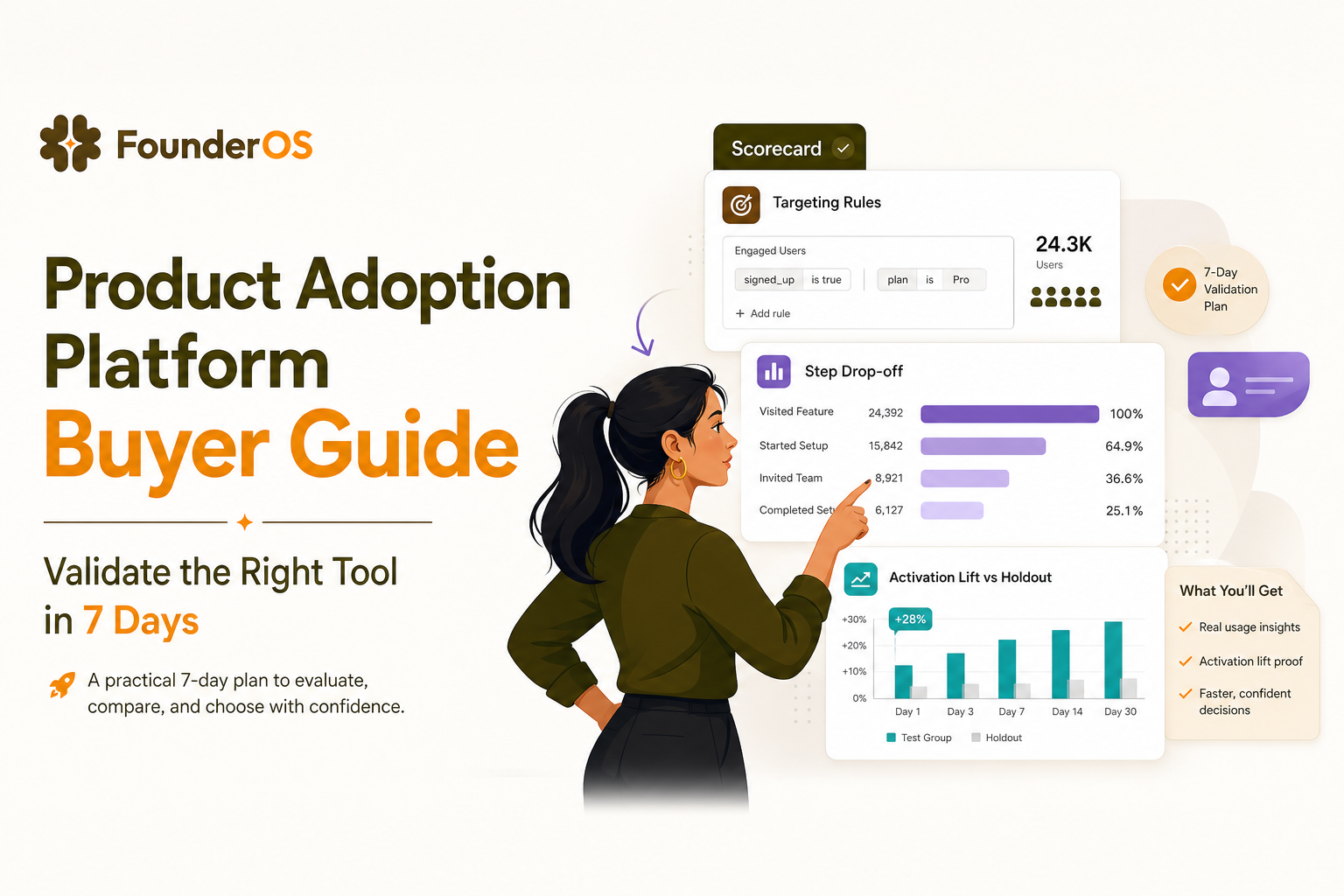
Solving product adoption platform validation in under 10 minutes with Founder OS
Once your blueprint is defined, the fastest path is a tool that lets you build the flow on your live product, target the right cohort, and measure completion and downstream impact without waiting on releases. Founder OS is used here as the efficiency engine for the 7-day pilot: it reduces setup time so your team spends time learning from data rather than fighting implementation.
No-code flow building that removes the engineering queue
For Step 3 of the blueprint, you need to ship a minimum viable onboarding flow quickly. Founder OS uses a Chrome extension that connects to your live product so a PM, growth lead, or founder can build modals, speech bubbles, tooltips, and surveys directly on the UI. The measurable output you want by end of Day 3 is simple: a flow that is live for the target cohort with a defined exit condition, not a backlog ticket.
If your team is evaluating no code onboarding, the key question is whether non-engineers can publish changes safely with QA and rollback.
Targeting and segmentation that makes experiments clean
For Step 2 and Step 4, the platform must support precise triggers and conditions: URL, user segment, behavior, and attributes, including conditional AND/OR logic. The measurable output by end of Day 4 is that only the intended persona sees the flow, and your holdout cohort is protected. Without this, your pilot results will be contaminated, and you will not be able to trust the lift.
Analytics that connect flow completion to activation outcomes
For Step 4 and Day 6, you need more than “tour completion.” Founder OS tracks completion, step drop-off, and how flows affect activation and retention in a growth dashboard. The measurable output by Day 6 is an exposed vs holdout comparison you can defend internally, plus a clear “fix list” based on drop-off steps.
If you are currently using basic product adoption software that cannot tie guidance to downstream events, you will feel this gap immediately during the 7-day plan.
| Week 1 validation requirement | What “good” looks like | Evidence to collect in 7 days |
|---|---|---|
| Activation-first success criteria | One activation event + time-to-value guardrail | Baseline vs exposed vs holdout activation and median time-to-value |
| Targeting and segmentation | Role/plan/attributes + behavior triggers + holdout support | Screenshot or export of rules, plus cohort counts that match expectations |
| Minimum viable onboarding flow | 3 to 6 action-driven steps with a stop condition | Step drop-off chart and completion rate by cohort |
| Instrumentation | Events and properties that map to product behavior | Event stream showing trigger, step, completion, and activation events |
| Governance and QA | Owner, reviewer, publish rights, rollback plan | Documented process and one successful rollback test |
FAQ about choosing and validating a product adoption platform
If you want to run this 7-day validation without stalling on implementation, Founder OS can help you build and publish the minimum viable onboarding flow quickly, target the right cohort with conditional logic, and measure step drop-off and activation impact so your product adoption platform decision is based on outcomes, not opinions.
Written by Ivy Tran
Founder of FounderOS, sharing practical insights on SaaS growth, product analytics, and user activation.
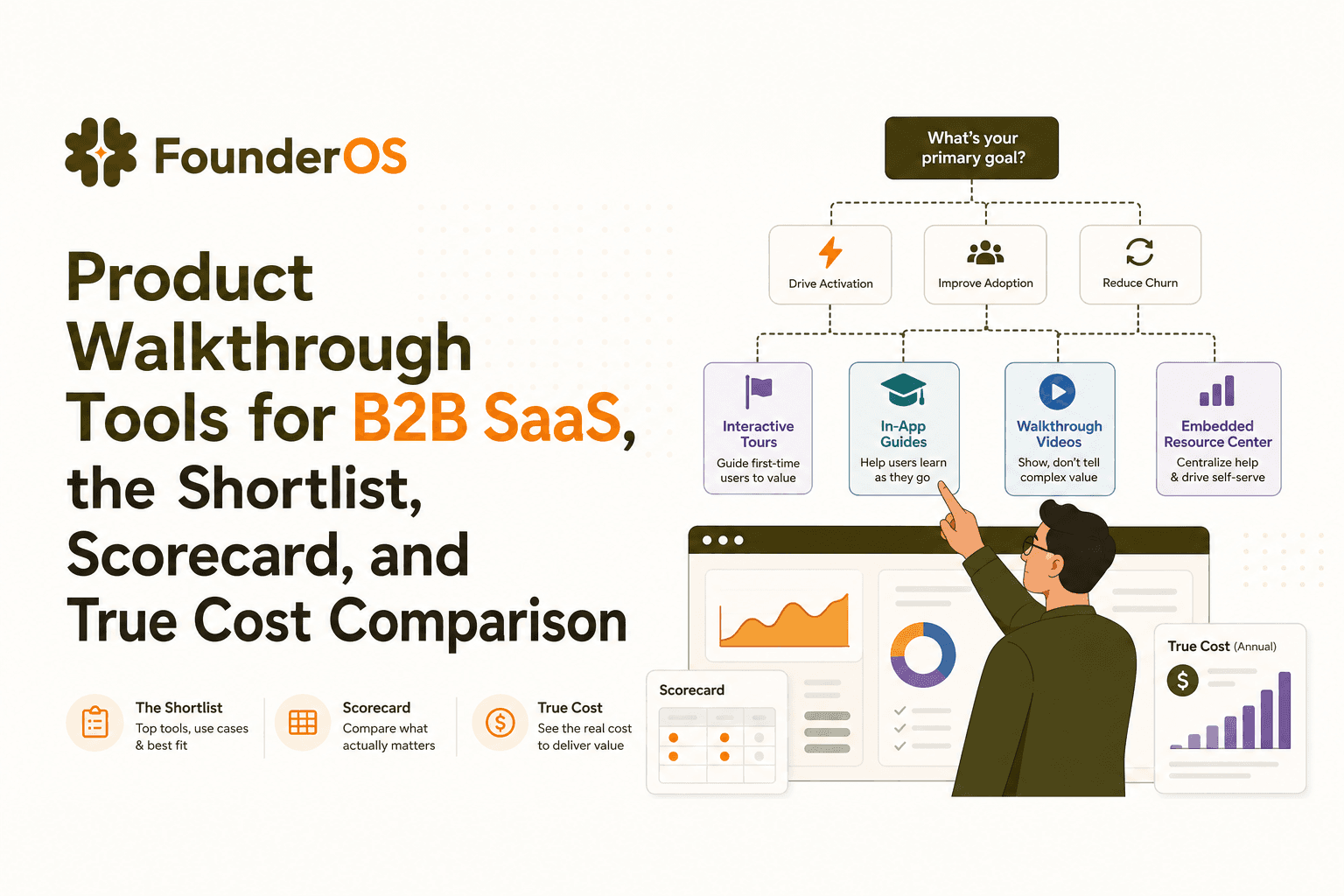
Product Walkthrough Tools for B2B SaaS, the Shortlist, Scorecard, and True Cost Comparison
Compare product walkthrough tools for B2B SaaS with a shortlist, success scorecard, and true cost scenarios for 2k, 10k, and 50k users.

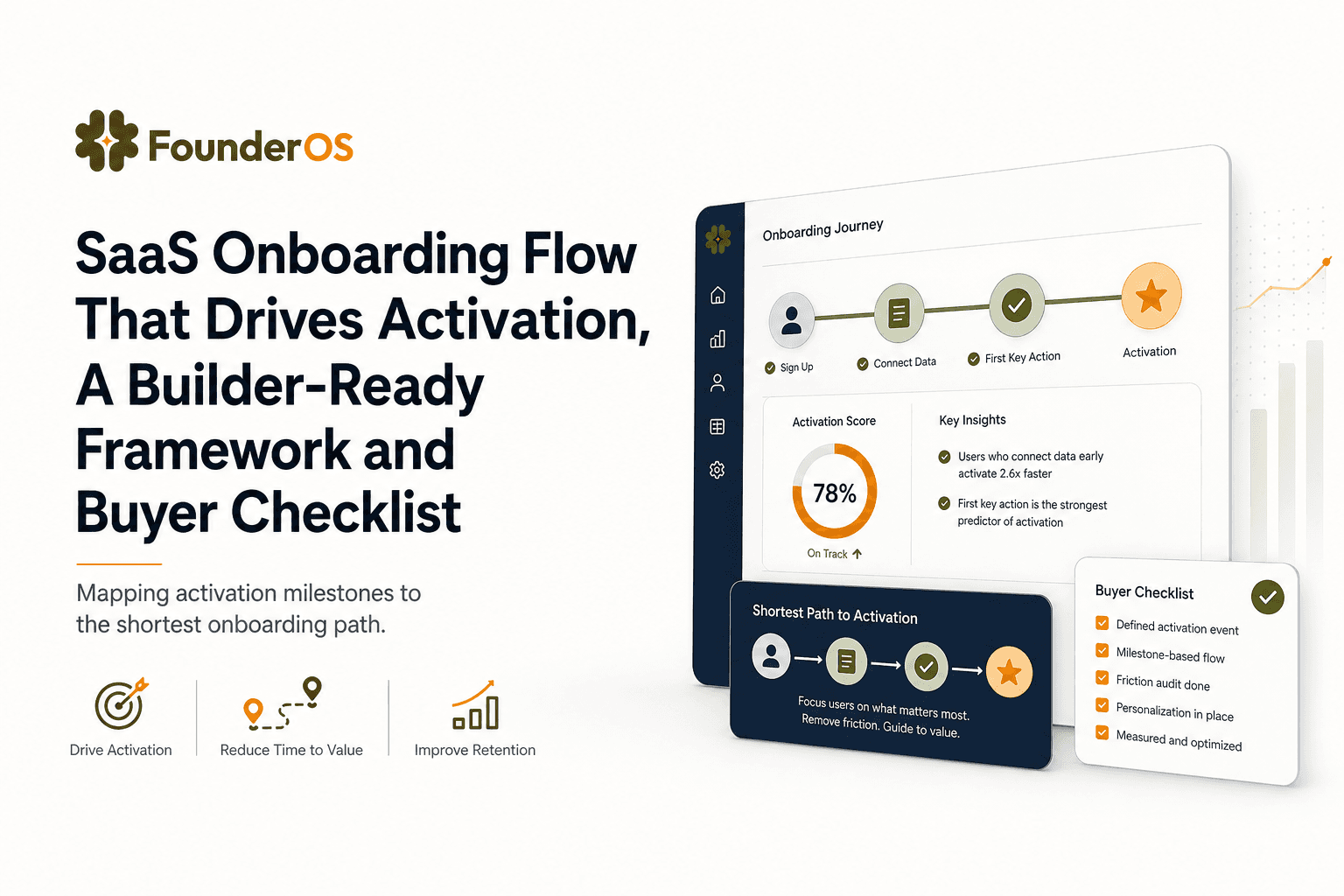
SaaS Onboarding Flow That Drives Activation, A Builder-Ready Framework and Buyer Checklist
Build a saas onboarding flow that drives activation with segments, triggers, tracking, and a buyer checklist for no-code flow builders.

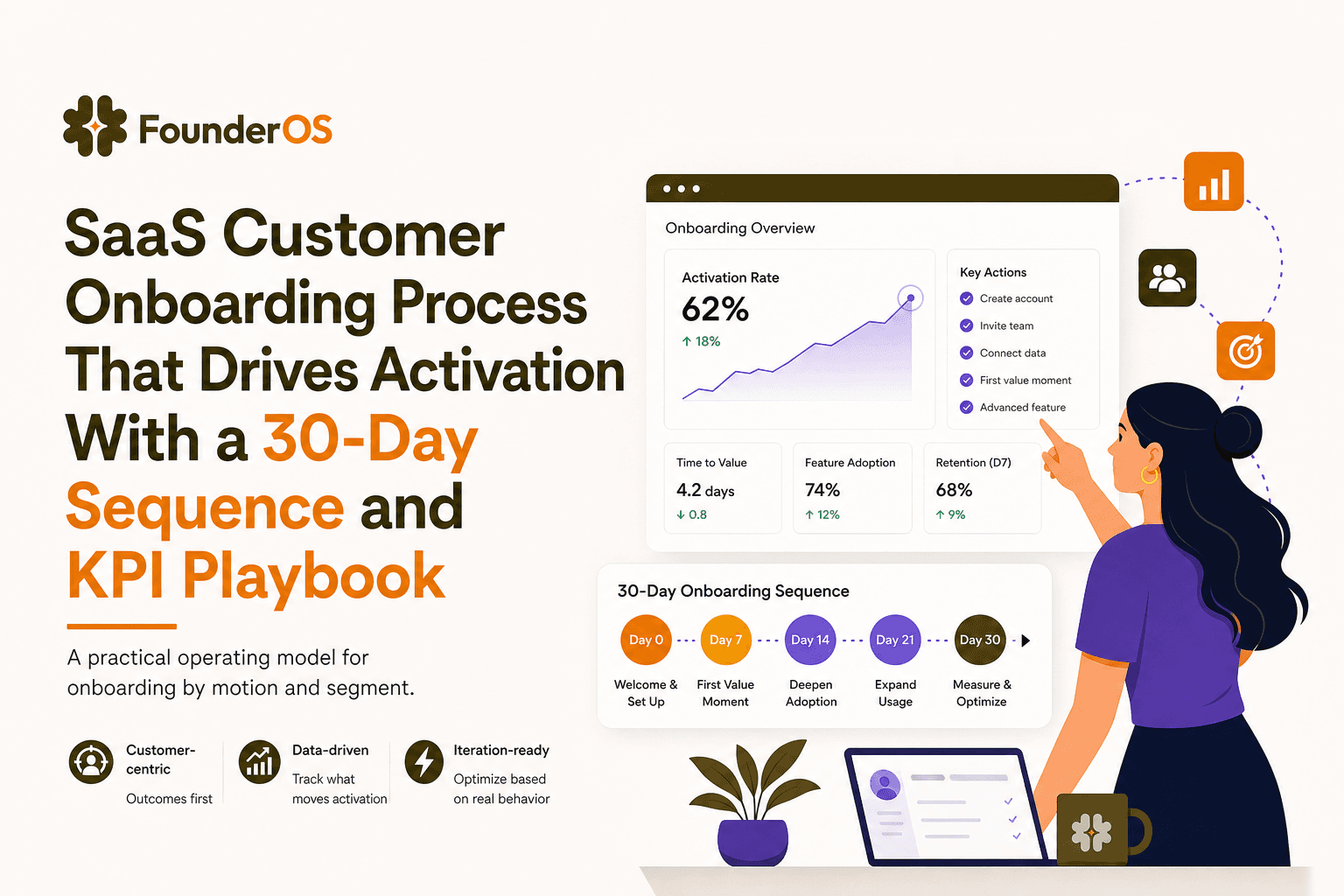
SaaS Customer Onboarding Process That Drives Activation With a 30-Day Sequence and KPI Playbook
Build a saas customer onboarding process with a 30-day sequence, triggers, RACI ownership, and KPI formulas to reach activation faster.
