
Customer Onboarding Process Explained for B2B SaaS Teams
The customer onboarding process is the path from signup to first value, and in B2B SaaS it should be designed around one clear success moment. If that path is vague, new customers stall before they understand the product, which is why teams often compare a customer onboarding process flow, an onboarding checklist, and the real time to value before they build anything.
- The customer onboarding process is not the same as implementation or long-term customer success.
- New users usually get stuck when setup is unclear, guidance is too broad, or the first value moment takes too long.
- A useful onboarding plan defines milestones, owners, and one measurable first success for every new customer.
What the customer onboarding process actually is
The boundary line between onboarding and everything else
The customer onboarding process is the sequence that moves a new customer from signup to the first successful outcome. It is narrower than implementation, which may include account setup and data migration, and narrower than customer success, which continues after adoption starts. The useful test is simple: if a step does not help the customer reach first value faster, it is probably not onboarding.
In practice, that means onboarding should answer three questions in order: what should the customer do first, what should they see next, and how will they know progress is real. When teams skip that order, they often create a long welcome path that feels complete but does not reduce confusion. We usually find that a clean definition helps more than adding more steps, because every extra step needs a clear reason to exist.
The core stages of the customer onboarding process are confirmation, setup, guided action, and first value
A stage map you can use immediately
The core stages of the customer onboarding process are easy to describe but easy to blur in execution. Confirmation tells the user they made the right choice, setup removes access and account barriers, guided action gets them to their first meaningful task, and first value proves the product can solve the problem they came to solve.
A practical stage map looks like this: confirmation should land inside the product or email within minutes, setup should ask only for the minimum data required to start, guided action should narrow the user to one next step, and first value should be visible enough to recognize without a support call. If a stage has more than one job, it usually becomes harder to measure and easier to ignore.
In our experience working with B2B SaaS teams, the first value stage matters most because it reveals whether the promise is real. If a user can complete one meaningful action and see the result, the customer onboarding process feels short even when the product is complex.
Most breaks in the customer onboarding process come from setup friction, information overload, and an unclear first win
Where drop-off usually happens
Most breaks in the customer onboarding process come from setup friction, information overload, and an unclear first win. Setup friction shows up when users need too many permissions, too much data, or a hidden integration before they can begin. Information overload shows up when the product, the email sequence, and the checklist all explain different things at once. An unclear first win shows up when the user can move through steps without reaching a visible result.
Those problems compound quickly. A customer who is asked to read, configure, and decide before seeing progress may not churn immediately, but their activation clock slows down. The fix is usually not more explanation. It is tighter sequencing, smaller tasks, and a first experience that ends with a visible result rather than a generic tour.
Take the same logic into any onboarding review: list the steps a customer must complete, mark the ones that require effort from another team, and flag anything that delays the first success moment. That simple audit often exposes the real issue faster than looking at open rates or click rates alone.
A simple framework turns the customer onboarding process into milestones, owners, and measurable signals
Map the process before you build the flow
A simple framework turns the customer onboarding process into milestones, owners, and measurable signals. Start with the first value moment, then write the one action that proves it happened, then assign a single owner for each stage. We usually map this on one page before any flow is built, because the page forces the team to choose what matters most.
Use this starter checklist: define the activation event, list the minimum steps before that event, pick the one message or in-app prompt that moves the user forward, and decide which metric proves the step worked. If you cannot name the metric, the step is probably still too vague. If you can name it, you can improve it.
Once the milestones are clear, the next question is delivery order. Lightweight email can confirm expectations, a checklist can reduce uncertainty, and in-app guidance should handle the actual moment of action. That order matters because users remember the product context best when help appears where the work happens. Teams that pair customer onboarding platform decisions with the right milestones usually end up with fewer alerts and a cleaner path to activation.
For a product-led onboarding motion, keep each touchpoint narrow: one email to orient, one checklist to frame progress, one guided in-app step to move action forward. A product onboarding tool can then trigger the right moment, while user segmentation keeps the experience relevant to role, account size, or behavior. The result is not more communication. The result is less confusion and a faster first win.
That framework also makes the customer onboarding process easier to improve later. Once the milestones are visible, you can compare completion rates by step, spot where people slow down, and decide whether the fix is better copy, a smaller requirement, or a different trigger entirely. The process becomes measurable instead of subjective.
Frequently asked questions
If you have already mapped your customer onboarding process, Founder OS can help turn it into measurable in-app onboarding flows with Product Onboarding Tool, User Segmentation, and Product Tracking so you can launch, learn, and improve without waiting on engineering.

Google Analytics Tracking Events in GA4, A Practical Setup Guide With GTM and gtag.js
Set up google analytics tracking events in GA4 with GTM or gtag.js, validate in DebugView, and turn events into conversions and funnels.

User Onboarding SaaS Explained, A Reusable Blueprint and Checklist
Learn user onboarding saas with a practical blueprint: stages, UI patterns, checklist, and a simple measurement plan to improve activation.
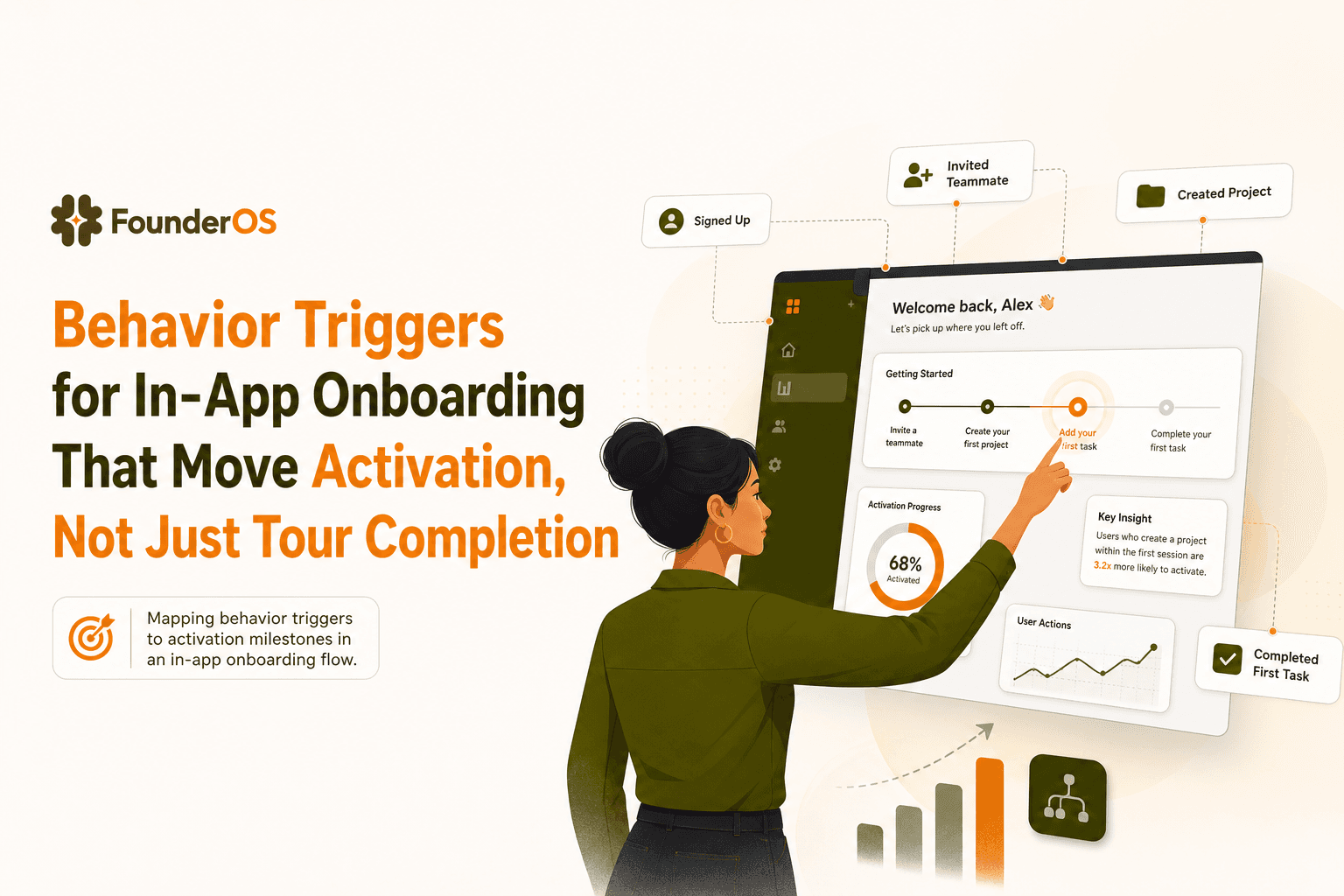
Behavior Triggers for In-App Onboarding That Move Activation, Not Just Tour Completion
Learn behavior triggers for in-app onboarding that drive activation milestones, not just tour completion. Includes trigger taxonomy, tests, and checklists.