
PostHog vs Mixpanel Pricing Reality, Setup Risk, and the Decision Checklist
PostHog vs Mixpanel usually comes down to two things teams fail to validate in trials: the true all-in cost once your event volume scales, and the implementation risk around identity, taxonomy, and environments.
- Choose faster by using 5 tie-breakers: cost drivers, identity model, data governance, workflow fit (replay/experiments/warehouse), and rollout risk.
- Run an apples-to-apples pricing worksheet using your real event volume, retention window, and “nice-to-have” add-ons, then set break-even checkpoints before you negotiate.
- De-risk setup with a 7-day acceptance-test checklist for identity merge rules, group analytics, environment separation, and data quality alerts.

PostHog vs Mixpanel in one line plus the 5 tie-breakers that matter
PostHog vs Mixpanel is easiest to decide when you treat them as two different bets: PostHog is a consolidation bet (more tools in one place), while Mixpanel is an event-analytics bet (best-in-class product analytics workflows) that often pairs with other tools.
One-line positioning you can use internally
- Pick PostHog when you want analytics plus adjacent workflows (for example replay and experimentation) in one product, and you are comfortable owning more of the configuration and governance details.
- Pick Mixpanel when your team needs polished product analytics, tight reporting workflows, and predictable day-to-day usage patterns across PM, growth, and lifecycle teams.
The 5 tie-breakers that end the debate
PostHog vs Mixpanel evaluations stall when teams compare feature checklists instead of these tie-breakers, which map directly to cost and rollout risk.
- Your cost driver is events, MTUs, or storage: decide which metric you can actually control quarter to quarter. If your product emits lots of “background” events, event-priced plans punish you unless you aggressively prune.
- Identity resolution model: confirm how anonymous-to-known merge works, what happens with shared devices, and whether merges are reversible. This is where most “data distrust” begins.
- Group analytics and B2B account views: if you sell to companies, validate “account = group” reporting, not just user-level funnels.
- Governance and environments: you need separation for dev/stage/prod, naming conventions, and alerting for schema drift. If that sounds heavy, pick the tool with fewer footguns for your team’s maturity.
- Workflow consolidation: decide whether you want one vendor for analytics plus replay/experiments, or best-of-breed analytics that integrates cleanly with your warehouse and engagement tools.
In our experience working with early-stage B2B SaaS teams, the fastest “yes” happens when the team chooses one primary constraint (cost controllability or implementation risk), then uses the other four tie-breakers only as veto checks.
Feature and workflow fit for funnels, retention, segmentation, replay, experiments, and warehouse
PostHog vs Mixpanel feature fit is best judged by the workflows your team runs weekly: funnel iteration, cohort building, retention review, and debugging why users drop off.
Use this workflow-first fit test (not a feature checklist)
Run each workflow below end-to-end in both trials using the same dataset and the same questions. The “winner” is the product that gets your non-technical stakeholders to the answer with fewer caveats.
- Activation funnel iteration: build a 5-step funnel, then add two breakdowns (source and persona) and compare week-over-week. Confirm you can save, version, and share the funnel in a way your team will actually reuse.
- Retention and cohorts: create a cohort like “activated in last 14 days and used Feature X twice” and verify it updates as new events arrive (not a static export).
- Segmentation depth: confirm you can filter by event properties, user properties, and account properties without turning the analysis into a SQL project.
- Debugging drop-offs: pick 10 users who dropped at step 3 and validate how quickly you can inspect their path and context (replay/session detail, if you plan to use it).
Where teams typically feel the difference
- Funnel and retention ergonomics: Mixpanel is often evaluated as the “daily driver” for PM and growth reporting because the interface is built around repeatable product analytics. PostHog is often evaluated as “good enough analytics plus extra tools,” but your team should confirm whether “good enough” is acceptable for weekly decision-making.
- Replay and experimentation consolidation: if you want replay and experiments alongside analytics, consolidation can reduce tool sprawl but increases the need to define governance early (what gets recorded, who can see it, and how long it is retained).
- Warehouse strategy: if your source of truth is the warehouse, prioritize how each tool handles ingestion, backfills, and consistency with BI. If your source of truth is the product itself, prioritize instrumentation speed and analyst-free iteration.
What surprised our team was how often the “best” tool flipped depending on who ran the analysis: PMs preferred the product that made saved reports and repeatable questions effortless, while engineers preferred the product that made instrumentation and debugging feel more transparent.
If you want a framework to keep event volume and naming from exploding during this evaluation, use a KPI-first approach before you instrument everything. The cleanest version is documented here: analytics events tracking.
Pricing and total cost with a reproducible worksheet and break-even checkpoints
PostHog vs Mixpanel pricing comparisons only become accurate when you normalize three inputs: billable volume, retention window, and paid add-ons you will actually turn on after week two.
The pricing worksheet (copy into a spreadsheet)
Use this worksheet structure so you can compare vendors without guessing their pricing math. Do not use “current events per month” alone; you need expected growth and the portion you can prune.
| Worksheet input | How to measure it | Why it changes the bill |
|---|---|---|
| Monthly tracked events (production) | Count from existing logs/SDKs; exclude dev/stage | Event-based billing punishes noisy instrumentation |
| Event prune rate (%) | Estimate % of events you can drop (debug, heartbeat) | Creates your “controllable cost” lever |
| Monthly tracked users / MTUs | Unique users with at least 1 event | User-based billing punishes wide but shallow usage |
| Retention window (days) | How long you need raw event detail available | Longer windows often increase cost or complexity |
| “Nice-to-have” modules you will enable | Replay, experiments, data pipelines, permissions | Add-ons can exceed base analytics cost |
| Seats and access tiers | Count real users by role (PM, Eng, CS, RevOps) | Per-seat pricing can creep quietly |
| Implementation labor (hours) | Instrument + QA + dashboards + governance | Your most ignored “line item” |
Apples-to-apples scenarios to run (three is enough)
- Today’s reality: current events and users, current retention window, minimal add-ons.
- 6-month growth: apply your expected growth rate and assume you only prune 10% to 30% of noise unless you have a dedicated analytics owner.
- “All the things”: add replay/experiments, longer retention, and more seats. Many teams discover the “nice-to-have” scenario becomes the real one by month two.
Break-even checkpoints you can use in negotiations
- Event volume breakpoint: at what monthly event count do you need to start sampling, pruning, or shifting detail to the warehouse?
- Replay breakpoint: if you enable session replay, what is the expected session volume, and will you record 100% or only for specific cohorts?
- Governance breakpoint: at what point do permissions, data deletion requests, and environment separation become mandatory (and is that included or a higher tier)?
For deeper cost mechanics and the common “gotchas” teams miss on plan pages, review posthog pricing and map the same categories to Mixpanel’s quote so your comparison stays symmetric.

Implementation due diligence for event taxonomy, identity resolution, group analytics, and data quality
PostHog vs Mixpanel implementation risk is predictable if you test identity merges, group analytics, and environment separation before you instrument your entire product.
A 7-day checklist that prevents “we don’t trust the data”
- Day 1: Define the minimum event contract
- Pick 10 to 20 events tied to activation, adoption, and retention.
- Define naming rules (verb_noun), required properties, and ownership.
- Decide what you will not track (debug, heartbeat, overly granular UI events) to control event spend.
- Day 2: Environments and filters
- Separate prod from dev/stage so test traffic never pollutes funnels.
- Confirm you can exclude internal users, QA accounts, and bots.
- Day 3: Identity resolution acceptance tests
- Anonymous to known: sign up, then log in on the same device and verify events stitch correctly.
- Cross-device: log in on a second device and confirm historical events merge the way you expect.
- Edge case: shared device or email aliasing. Decide your “source of truth” identifier and confirm the tool can respect it.
- Day 4: Group analytics for B2B accounts
- Model an account (company) and validate account-level funnels and retention.
- Validate multi-user accounts and role changes over time (user switches account, user belongs to multiple workspaces).
- Day 5: Data quality and drift
- Break an event property intentionally in staging and see how quickly you detect it.
- Confirm how schema changes appear to non-technical users (silent failures are the enemy).
- Day 6: Reporting workflow hardening
- Create 3 canonical dashboards: activation, feature adoption, retention.
- Check permissions for who can edit vs view so metrics do not “move” accidentally.
- Day 7: Export and exit plan
- Confirm raw event export options and what is needed to reconstruct metrics elsewhere.
- Document identity rules, event contract, and the dashboard definitions as part of your rollout playbook.
The three most common failure modes (and how to test them)
- Failure mode 1: duplicate users inflate funnels. Test by creating one person with two devices and one with two emails; verify your merges match your business logic.
- Failure mode 2: “event soup” makes analysis slow and expensive. Test by instrumenting only the activation path first and enforcing required properties before opening the floodgates.
- Failure mode 3: prod metrics drift after releases. Test by setting a pre-release checklist: compare yesterday vs today counts for the top 10 events, and alert on sharp changes.
After running multiple instrumentation audits, the pattern was clear: teams that formalize a small event contract and identity rules in week one migrate faster than teams that “just start tracking” and fix naming later.
If you want a deeper playbook on building funnels from clean instrumentation through conversion improvements, this guide is a solid reference: funnel analysis.
What practitioners say on forums and the trial questions you can validate
PostHog vs Mixpanel sentiment online clusters into repeatable themes that you can translate into objective acceptance tests rather than opinions.
Theme 1: “Costs surprised us” usually means instrumentation was noisy
- What to validate: how quickly you can identify top event producers and prune them without breaking reports.
- Trial question: “Can we cut 20% of event volume in one hour and keep our activation dashboards intact?”
Theme 2: “We couldn’t trust identity” usually means merges were undefined
- What to validate: exact merge precedence, how aliasing works, and how mistakes are corrected.
- Trial question: “If a user signs up with Google then later with email, do we get one profile or two, and can we reconcile it?”
Theme 3: “PM adoption was low” usually means reports were hard to operationalize
- What to validate: saved reports, annotations, share links, and whether non-technical users can slice without breaking definitions.
- Trial question: “Can a PM answer ‘what retained users do in week 1’ without asking analytics engineering?”
Theme 4: “It worked, but we needed a data person” is a governance signal
- What to validate: role-based access, metric definitions, schema governance, and guardrails against accidental changes.
- Trial question: “Can we lock the canonical activation definition while still letting teams explore?”
To keep this evidence-based, do your forum reading only after you run the acceptance tests above. Then use external documentation to confirm specific behaviors (identity merge rules, retention limits, export options) from primary sources like vendor docs. A good neutral baseline for privacy and security expectations is the SOC 2 overview from AICPA: SOC reports and controls.
If you are also considering Amplitude or GA4 use this decision tree
PostHog vs Mixpanel is the right comparison only if you need product event analytics; if your core need is marketing attribution or basic web traffic reporting, GA4 can be the better default.
A practical decision tree
- If your primary questions are acquisition and web attribution: start with GA4 and add product analytics only when you need user-level paths and in-app conversion detail. If you are already debating this, use: posthog vs google analytics.
- If you need deep product analytics for PM and growth: Mixpanel and Amplitude are usually the short list; pick the one your team will actually use weekly based on saved reports, cohort ergonomics, and governance fit.
- If you want consolidation across analytics plus adjacent tooling: PostHog is the more direct consolidation bet, but only if you are willing to run the due diligence checklist on identity, environments, and data quality first.
- If your company already lives in the warehouse: prioritize tools that make warehouse sync and consistent definitions easy, and consider whether you should keep heavy analysis in BI while using product analytics for exploration and iteration.
When PostHog or Mixpanel is the wrong choice
- Wrong for purely marketing reporting: if you do not need in-app event paths, product analytics tools can become expensive dashboards.
- Wrong when you cannot commit to governance: if nobody owns event naming, identity rules, and dashboard definitions, any tool will degrade into mistrusted metrics.
| Decision factor | Pick PostHog when... | Pick Mixpanel when... | Acceptance test in your trial |
|---|---|---|---|
| Primary goal | You want one platform covering analytics plus adjacent workflows | You want product analytics excellence as the daily reporting layer | Build the same activation dashboard and see who reuses it weekly |
| Cost controllability | You can manage event volume and governance proactively | You can forecast user/seat usage better than raw event growth | Identify top 10 event producers and prune 20% without breaking reports |
| Identity and B2B accounts | You can validate and document merge rules and group models early | You need strong, repeatable account and user reporting for teams | Run anonymous-to-known, cross-device, and account-level funnel tests |
| Governance maturity | You have an owner for event contract and dashboards | You want guardrails that keep reports stable for stakeholders | Lock definitions, set permissions, and test schema drift visibility |
| Exit strategy | You need flexibility and are planning export/warehouse sync | You want a stable reporting layer with minimal operational overhead | Confirm raw export and ability to rebuild key metrics elsewhere |
FAQ
If your PostHog vs Mixpanel evaluation is really about getting to reliable activation and retention insights fast, Founder OS is built to shorten the time from install to first useful dashboard with product tracking, unified user profiles and segmentation, plus GTM reporting and onboarding workflows in one place. Book a demo and we will map your real events into funnels and segments during the call so you can see the rollout plan before you migrate.
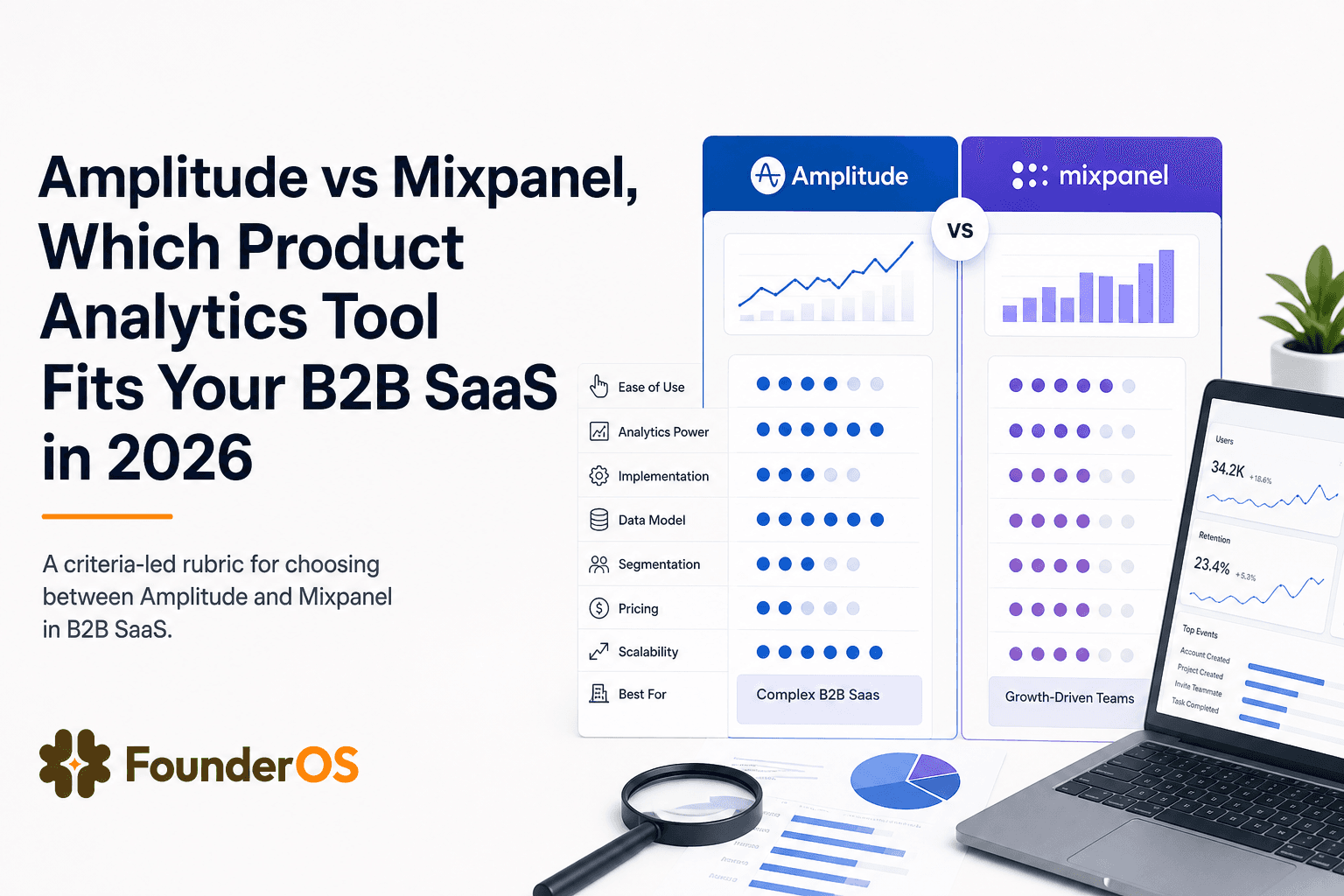
Amplitude vs Mixpanel, Which Product Analytics Tool Fits Your B2B SaaS in 2026
Amplitude vs Mixpanel comparison for B2B SaaS teams in 2026. Use a fast rubric for data model fit, analysis depth, collaboration, and TCO.

Guided Product Tour Blueprint to Ship a Measurable Activation Flow in 72 Hours
A guided product tour blueprint to ship in 72 hours: define the promise, map steps to events, segment entry rules, and measure activation.
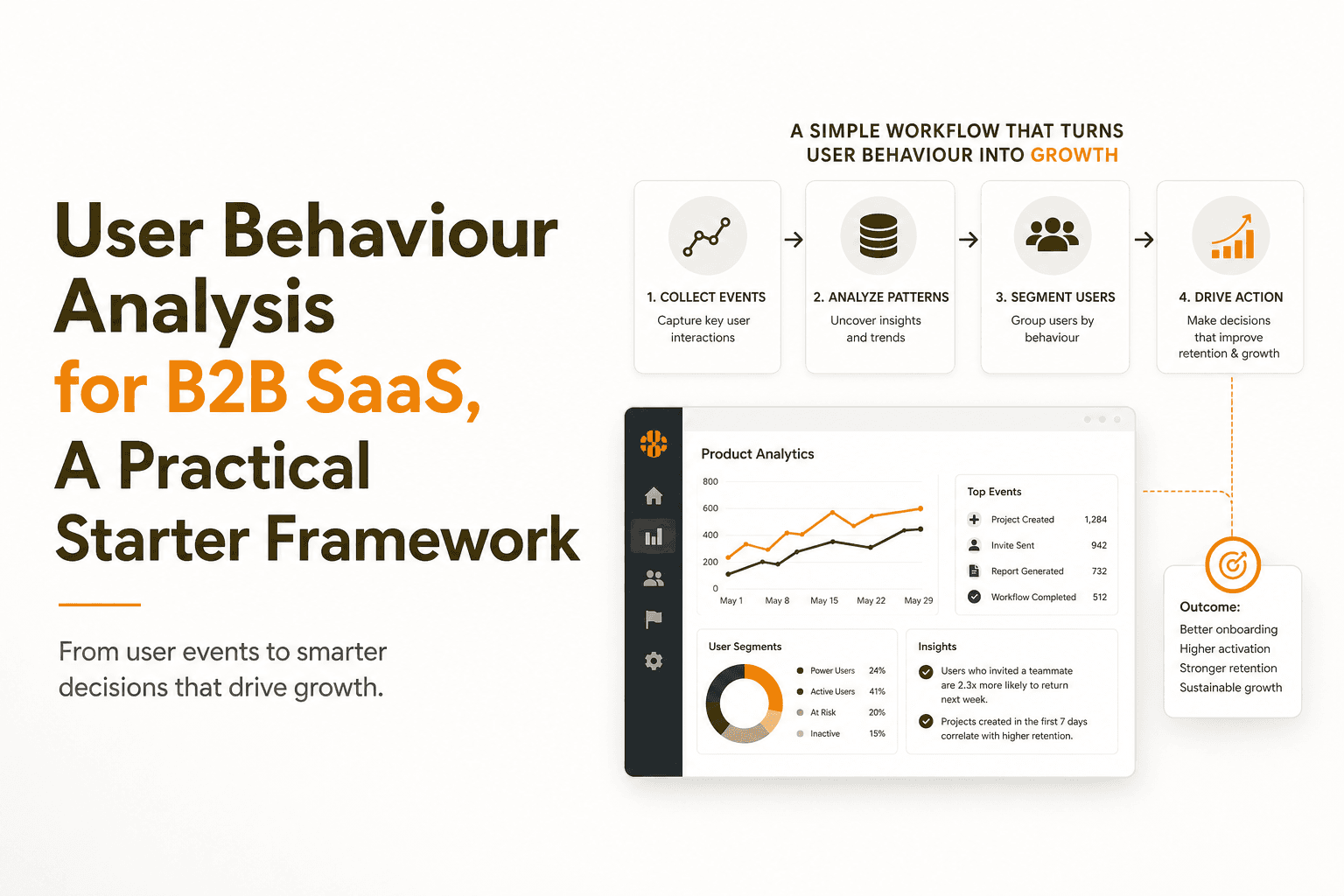
User Behaviour Analysis for B2B SaaS, A Practical Starter Framework
Learn user behaviour analysis for B2B SaaS with a practical framework: what to track first, core analyses, pitfalls, and how to turn insights into growth.